Free admission
Вход свободный
Daily from 11:00 AM to 8:00 PM
| Free admission
 Home
Home
VISION CHECK
Yuri Avvakumov
July 20 — August 8, 2012
Triumph gallery
Triumph gallery
On July 20, a new exhibition by Yuri Avvakumov will open, united by the theme of a person’s attitude to surrounding things and objects. The three photographic series and objects included in the Vision Check project are visual puzzles that offer to discover the differences between what we see and what it really is.

In the photographs of the city of Igarka in the Krasnoyarsk Territory, views of Moscow, New York, London and other cities in the "Starry Sky" series, Avvakumov draws the threads of constellations characteristic of a particular area. The designations of the celestial world, imagined by ancient cartographers and non-existent in reality, become visible and almost real here, thanks to the brilliance of the rhinestones with which the stars are applied to the photographs.
Cleansing
2010
Video
19’ 47’’
2010
Video
19’ 47’’
Cleansing
2010
Video
19’ 47’’
2010
Video
19’ 47’’
In the photographs of the city of Igarka in the Krasnoyarsk Territory, views of Moscow, New York, London and other cities in the "Starry Sky" series, Avvakumov draws the threads of constellations characteristic of a particular area. The designations of the celestial world, imagined by ancient cartographers and non-existent in reality, become visible and almost real here, thanks to the brilliance of the rhinestones with which the stars are applied to the photographs.
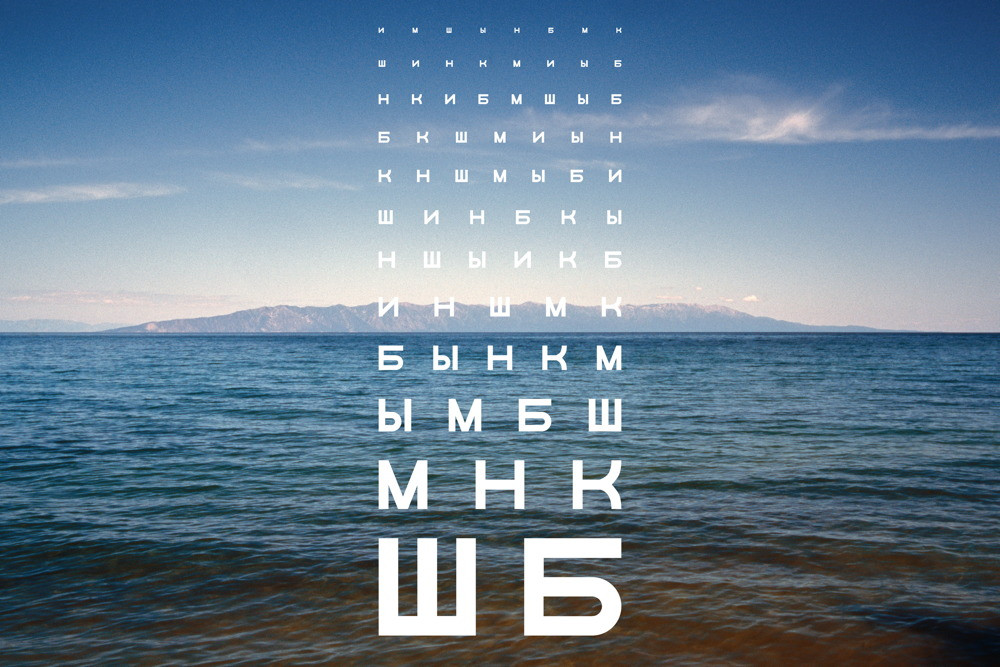
In the "Tables" series, the artist combines water landscapes with tables for vision testing: the classic "SBMNK" by Sivtsev, graphic ones with Landolt rings and Snellen hooks, and the Orlova table for children, where pictures are depicted instead of symbols and letters. Avvakumov performs a deliberate optical trick and places the tables upside down — the viewer’s gaze goes from the large letters located at the bottom of the work to the horizon line in the landscape, where the symbols decrease. Thus, two-dimensional photographic images acquire a third spatial dimension, forcing them to look more closely than usual into the infinite distance.

In the "Tables" series, the artist combines water landscapes with tables for vision testing: the classic "SBMNK" by Sivtsev, graphic ones with Landolt rings and Snellen hooks, and the Orlova table for children, where pictures are depicted instead of symbols and letters. Avvakumov performs a deliberate optical trick and places the tables upside down — the viewer’s gaze goes from the large letters located at the bottom of the work to the horizon line in the landscape, where the symbols decrease. Thus, two-dimensional photographic images acquire a third spatial dimension, forcing them to look more closely than usual into the infinite distance.

The Twin Towers series is based on an optical illusion discovered at McGill University in Canada: when two identical photographs of the tower are placed side by side, the right one always appears to fall. A simple focus knocks down visual settings, disrupting gravity. Continuing to reflect on the topic of vision, Avvakumov also presents an object made of round mirrored lenses arranged according to Braille. And a situation arises when the text made up of them is accessible only to the sighted, and people using this alphabet will not be able to read it.
The Twin Towers series is based on an optical illusion discovered at McGill University in Canada: when two identical photographs of the tower are placed side by side, the right one always appears to fall. A simple focus knocks down visual settings, disrupting gravity. Continuing to reflect on the topic of vision, Avvakumov also presents an object made of round mirrored lenses arranged according to Braille. And a situation arises when the text made up of them is accessible only to the sighted, and people using this alphabet will not be able to read it.

The "vision test" shows that the visible is an appearance, and the objectivity of vision, as one of the strongest senses of human perception, is broken with the help of visual illusions. As curator Ekaterina Inozemtseva notes: "Avvakumov deftly shuffles meanings, juggles with audience expectations, then almost breaks through to the absolute and, it seems, indisputable, then again shows us such tricks from which we do not really feel powerless — far from it, but ironically accept as inevitable the multiplicity of reality and our perception, layering impressions and meanings."
The "vision test" shows that the visible is an appearance, and the objectivity of vision, as one of the strongest senses of human perception, is broken with the help of visual illusions. As curator Ekaterina Inozemtseva notes: "Avvakumov deftly shuffles meanings, juggles with audience expectations, then almost breaks through to the absolute and, it seems, indisputable, then again shows us such tricks from which we do not really feel powerless — far from it, but ironically accept as inevitable the multiplicity of reality and our perception, layering impressions and meanings."
© All rights reserved.
Free admission
Daily from 11:00 AM to 8:00 PM
WE ARE OPEN
Contacts
MENU
