Free admission
Вход свободный
Daily from 11:00 AM to 8:00 PM
| Free admission
 Home
Home
maxims
Anastasia zaborovskaya
June 16 — June 26, 2012
Triumph gallery
Triumph gallery
LAUNCHPAD PROJECT
As part of Triumph Gallery’s Launchpad project, which showcases emerging artists, four exhibitions will be held in June. From June 16th to 26th, solo exhibitions by Ustina Yakovleva and Anastasia Zaborovskaya will be held. Curator Vladimir Potapov.
As part of Triumph Gallery’s Launchpad project, which showcases emerging artists, four exhibitions will be held in June. From June 16th to 26th, solo exhibitions by Ustina Yakovleva and Anastasia Zaborovskaya will be held. Curator Vladimir Potapov.

Anastasia Zaborovskaya (b. 1988 in St. Petersburg) graduated from the St. Petersburg State Academy of Art and Design named after A.L. Stieglitz. In 2009, the artist’s first solo exhibition was held at the Vostochnaya Gallery. Zaborovskaya also participated in the Biennale for Young Art "Stop! Who Goes There?" (2008, 2010), and in 2012, her works were included in the parallel program of the IV Moscow Biennale of Contemporary Art.
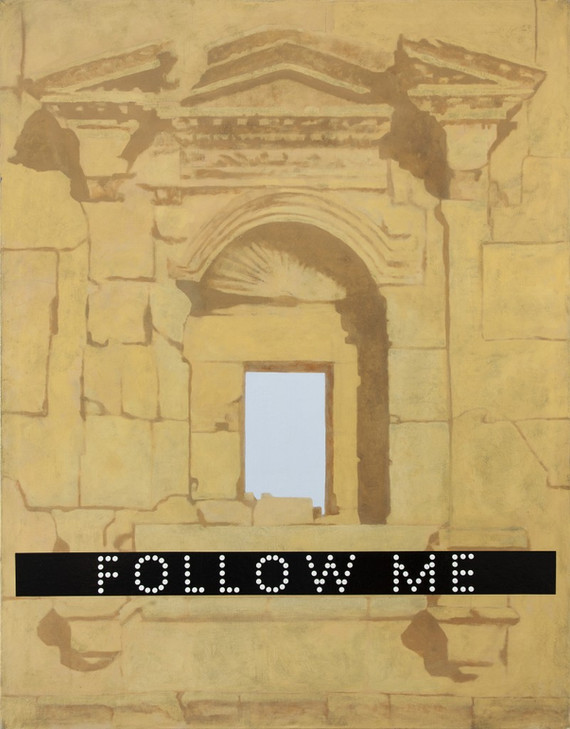
Follow Me
2012
Oil on canvas, analgin tablets
180 × 140 cm
2012
Oil on canvas, analgin tablets
180 × 140 cm
Follow Me
2012
Oil on canvas, analgin tablets
180 × 140 cm
2012
Oil on canvas, analgin tablets
180 × 140 cm
Anastasia Zaborovskaya (b. 1988 in St. Petersburg) graduated from the St. Petersburg State Academy of Art and Design named after A.L. Stieglitz. In 2009, the artist’s first solo exhibition was held at the Vostochnaya Gallery. Zaborovskaya also participated in the Biennale for Young Art "Stop! Who Goes There?" (2008, 2010), and in 2012, her works were included in the parallel program of the IV Moscow Biennale of Contemporary Art.
Anastasia Zaborovskaya’s project "Maxims" encapsulates a catechism for modern man living in a precarious situation. On canvases depicting the structures of great civilizations, the artist uses a running line of painkiller tablets to spell out common phrases that permeate society today. These maxims, embedded in ruins, as if cleaned by archaeologists from the dust of centuries, illustrate the myth of eternal return. The inscriptions made from painkillers—"Follow me" under the window of a ruined building in Carthage, "Don't call anywhere" on the portico of the Parthenon, and "Patriot games" at the Colosseum—are essential therapy with a happy ending: the exhibition concludes with the phrase "Everything will still be."

Anastasia Zaborovskaya’s project "Maxims" encapsulates a catechism for modern man living in a precarious situation. On canvases depicting the structures of great civilizations, the artist uses a running line of painkiller tablets to spell out common phrases that permeate society today. These maxims, embedded in ruins, as if cleaned by archaeologists from the dust of centuries, illustrate the myth of eternal return. The inscriptions made from painkillers—"Follow me" under the window of a ruined building in Carthage, "Don't call anywhere" on the portico of the Parthenon, and "Patriot games" at the Colosseum—are essential therapy with a happy ending: the exhibition concludes with the phrase "Everything will still be."
© All rights reserved.
Free admission
Daily from 11:00 AM to 8:00 PM
WE ARE OPEN
Contacts
MENU
