Free admission
Вход свободный
Daily from 11:00 AM to 8:00 PM
| Free admission
 Home
Home
Clutching at the scraps of the past
Lucy McLaughlan
March 22 — April 7, 2013
Triumph gallery
Triumph gallery
Lucy McLaughlan, a young artist from Birmingham (UK), has a recognizable artistic style — her monochrome paintings can be found in many European countries on the facades of buildings. At one time, Lucy founded the artistic and musical group Beat 13 and was an active participant in many underground parties. Her work has been exhibited in the United States, the United Kingdom, Germany, Portugal, Italy, Belgium, Spain, Japan, and the Gambia, and has been included in the collections of the Victoria and Albert Museum (London) and Soho House (Los Angeles and London).

McLaughlan blends psychedelia and primitivism to create monumental and provocative works that range from paintings and graphics to sculptures and street art. The artist finds old cars, logs, doors, trays, plates, cans, cutlery, and other utensils among the garbage and turns them into art objects. MacLaughlan uses high-rise buildings as a field for her experiments, having painted an electrical tower and a water tower in Italy, abandoned tunnels in the New York subway, and the wall of the historic Arts Club in London’s fashionable Mayfair district.
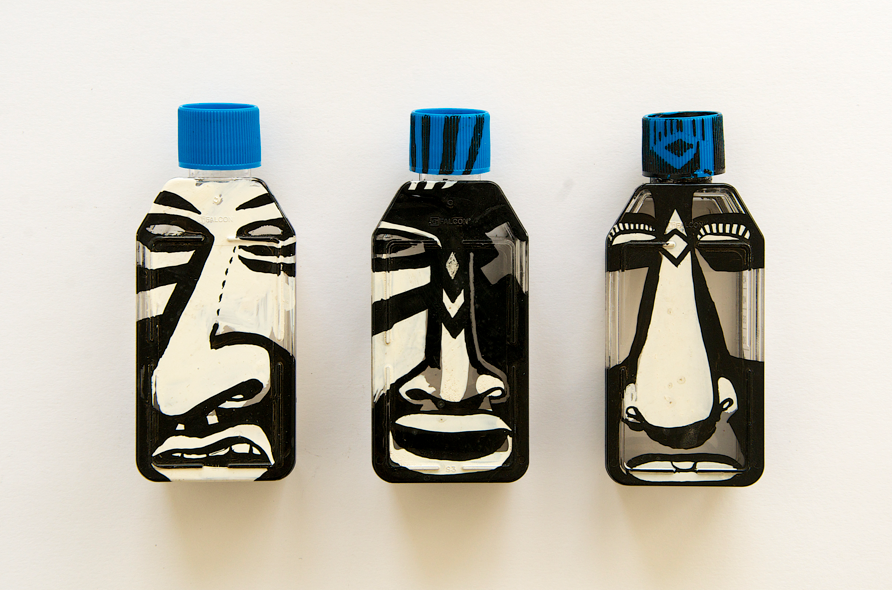
No title
2009
18 bottles for collecting samples, emulsion, ink
10.5 × 4.4 cm each
2009
18 bottles for collecting samples, emulsion, ink
10.5 × 4.4 cm each
No title
2009
18 bottles for collecting samples, emulsion, ink
10.5 × 4.4 cm each
2009
18 bottles for collecting samples, emulsion, ink
10.5 × 4.4 cm each
McLaughlan blends psychedelia and primitivism to create monumental and provocative works that range from paintings and graphics to sculptures and street art. The artist finds old cars, logs, doors, trays, plates, cans, cutlery, and other utensils among the garbage and turns them into art objects. MacLochlan uses high-rise buildings as a field for her experiments, having painted an electrical tower and a water tower in Italy, abandoned tunnels in the New York subway, and the wall of the historic Arts Club in London’s fashionable Mayfair district.
At her first exhibition in Russia, McLaughlan will present a series of masks made from found objects, as well as paintings that draw inspiration from primitive art. The atmosphere of the street will be recreated by a large-scale painting on the gallery wall, with elements of an installation of garbage artifacts collected by Lucy in Moscow. Two videos will show the artist’s process of working on various surfaces.

At her first exhibition in Russia, McLaughlan will present a series of masks made from found objects, as well as paintings that draw inspiration from primitive art. The atmosphere of the street will be recreated by a large-scale painting on the gallery wall, with elements of an installation of garbage artifacts collected by Lucy in Moscow. Two videos will show the artist’s process of working on various surfaces.

Lucy McLaughlan’s work is an endless ornamental pattern that appears on every object she touches. Arseny Steiner, an art historian and art critic, notes: "In a miraculous way, Lucy McLaughlan resurrects the creative method of the pre-literate era, when myth was the means of transmitting knowledge, and history was no different from cosmogony, and images were a true language, but not a means of communication between people, but a means of communication between people and the full-blooded, uncastrated civilization of the universe."
Lucy McLaughlan’s work is an endless ornamental pattern that appears on every object she touches. Arseny Steiner, an art historian and art critic, notes: "In a miraculous way, Lucy McLaughlan resurrects the creative method of the pre-literate era, when myth was the means of transmitting knowledge, and history was no different from cosmogony, and images were a true language, but not a means of communication between people, but a means of communication between people and the full-blooded, uncastrated civilization of the universe."
© All rights reserved.
Free admission
Daily from 11:00 AM to 8:00 PM
WE ARE OPEN
Contacts
MENU
