Free admission
Вход свободный
Daily from 11:00 AM to 8:00 PM
| Free admission
 Home
Home
Cy
Maksim Ksuta
March 7 — March 17, 2013
Triumph gallery
Triumph gallery
Over the past few years, Maxim Ksuta has developed a very special relationship with photography: he consistently removes and weakens the strong connection between the photographic image and the visible reality.

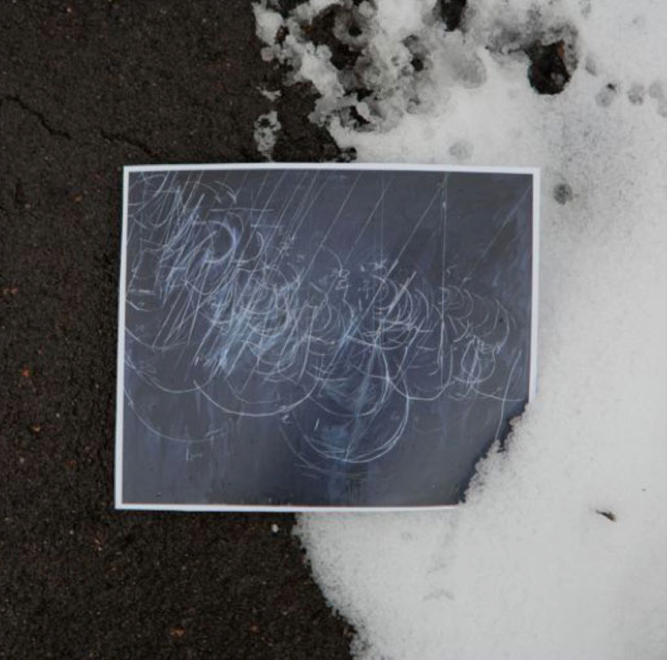
In his hands, the camera ceases to be a means of "exposing" reality and capturing it in its most concentrated form. Instead, it seems to transcend its technological nature, and Ksuta seems to be drawing with a brush or charcoal pencil rather than pressing the shutter. He deliberately forms not a frame, but a sheet with a geometric abstraction, and his works begin to live according to the laws of a graphic sheet, rather than a photographic print, as was the case in his previous series of electric wires cutting through the Moscow sky with dynamic diagonals.
Reproduction of the work by Sia Tuombley "Untitled"
2013
Photo
50 × 50 cm
2013
Photo
50 × 50 cm
Reproduction of the work by Sia Tuombley "Untitled"
2013
Photo
50 × 50 cm
2013
Photo
50 × 50 cm
In his hands, the camera ceases to be a means of "exposing" reality and capturing it in its most concentrated form. Instead, it seems to transcend its technological nature, and Ksuta seems to be drawing with a brush or charcoal pencil rather than pressing the shutter. He deliberately forms not a frame, but a sheet with a geometric abstraction, and his works begin to live according to the laws of a graphic sheet, rather than a photographic print, as was the case in his previous series of electric wires cutting through the Moscow sky with dynamic diagonals.
Along the way, Maxim Ksuta continues to solve his own problem, which has been preoccupying him recently: he is trying to find the subtle zone where the concrete and the abstract coexist. A concrete object is often embodied in an extremely abstract form, losing its recognizable shape but not its essence: a branch remains a branch, a patch of wormwood remains a patch of wormwood, and the viewer is easily drawn into this mesmerizing formal game, the shimmering of the tangible and the visible.

Along the way, Maxim Ksuta continues to solve his own problem, which has been preoccupying him recently: he is trying to find the subtle zone where the concrete and the abstract coexist. A concrete object is often embodied in an extremely abstract form, losing its recognizable shape but not its essence: a branch remains a branch, a patch of wormwood remains a patch of wormwood, and the viewer is easily drawn into this mesmerizing formal game, the shimmering of the tangible and the visible.

He follows the logic of the "new objectivity," evoking the German "Neue Sachlichkeit," and, like many young European artists (especially those from Eastern Europe of the Wilhelm Sasnál generation), he sees this as an opportunity for quiet release. He suddenly realizes that the range of variations can be as wide as desired, and with a craftsman’s tenacity (in the best sense of the ancient techné), he continues to navigate this magical space, occasionally drawing in the great artists of the 20th century.
He follows the logic of the "new objectivity," evoking the German "Neue Sachlichkeit," and, like many young European artists (especially those from Eastern Europe of the Wilhelm Sasnál generation), he sees this as an opportunity for quiet release. He suddenly realizes that the range of variations can be as wide as desired, and with a craftsman’s tenacity (in the best sense of the ancient techné), he continues to navigate this magical space, occasionally drawing in the great artists of the 20th century.
© All rights reserved.
Free admission
Daily from 11:00 AM to 8:00 PM
WE ARE OPEN
Contacts
MENU
