Free admission
Вход свободный
Daily from 11:00 AM to 8:00 PM
| Free admission
 Home
Home
DIESELPUNK
valentin tkach
November 22 — December 15, 2013
Triumph gallery
Triumph gallery
Modern man, a place beyond time.

Valentin Tkach’s first painting project was about the viewer’s gaze, it was called "Vertigo", and this cinematic reference softened the persuasiveness of the impossible, which art invents to explain reality. What Tkach used to seek reconciliation with —the collapse of the empire, the end of history, the death of modernism, blah blah blah — in his new series "Dieselpunk" simply dissolves into the post-apocalypse. The weaver is no longer hiding anything, although the name adds little to the actual painting. As a basic model of completion discourses, the post-apocalypse connects disparate aspects of modernity into a single representation, and the picture with its single position of looking at the world authoritatively gathers disparate fragments of reality into a convincing puzzle.
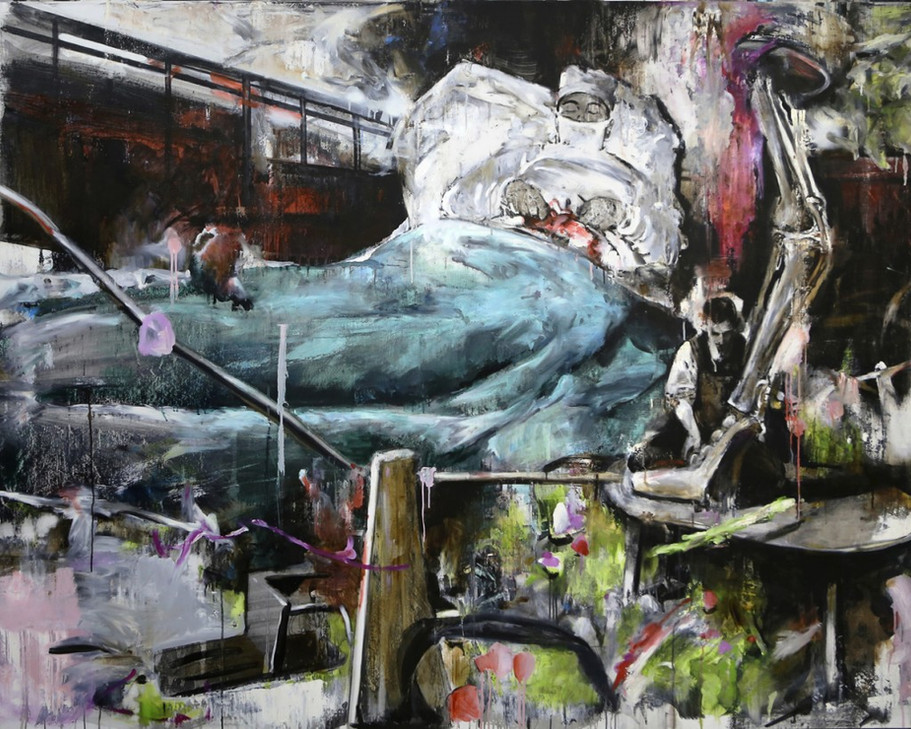
Operation
2012
Oil on canvas, acrylic
160 × 200 cm
2012
Oil on canvas, acrylic
160 × 200 cm
Operation
2012
Oil on canvas, acrylic
160 × 200 cm
2012
Oil on canvas, acrylic
160 × 200 cm
Valentin Tkach’s first painting project was about the viewer’s gaze, it was called "Vertigo", and this cinematic reference softened the persuasiveness of the impossible, which art invents to explain reality. What Tkach used to seek reconciliation with —the collapse of the empire, the end of history, the death of modernism, blah blah blah — in his new series "Dieselpunk" simply dissolves into the post-apocalypse. The weaver is no longer hiding anything, although the name adds little to the actual painting. As a basic model of completion discourses, the post-apocalypse connects disparate aspects of modernity into a single representation, and the picture with its single position of looking at the world authoritatively gathers disparate fragments of reality into a convincing puzzle.
Tkach’s keen interest in the ability of art to interpret reality is fueled by the similarity of phantasmagoria, placed behind the facade of reality as its invisible mechanism, and personal phantasms, which are also invariably hidden and at the same time active in the reality of any subject.

Tkach’s keen interest in the ability of art to interpret reality is fueled by the similarity of phantasmagoria, placed behind the facade of reality as its invisible mechanism, and personal phantasms, which are also invariably hidden and at the same time active in the reality of any subject.

The space in his paintings becomes impossible and works solely on the failure of our imagination, it distorts the scale, relationships and horizon. Animals also behave strangely — a mammoth, for example, fits under a boy’s armpit. Animals and space change, but not man, because the perfect cannot change — the surgeon continues to operate, the viewer watches, the boy plays and hooligans, the boxer boxes, etc. — An anthropological tautology is imputed to the world as a deadly virus, and the world is dying. The immutability of human nature becomes a place of absurdity, a place where the world continues beyond time, on the ruins of civilization, among piles of garbage and abandoned buildings. This is our real invisible modernity.
The space in his paintings becomes impossible and works solely on the failure of our imagination, it distorts the scale, relationships and horizon. Animals also behave strangely — a mammoth, for example, fits under a boy’s armpit. Animals and space change, but not man, because the perfect cannot change — the surgeon continues to operate, the viewer watches, the boy plays and hooligans, the boxer boxes, etc. — An anthropological tautology is imputed to the world as a deadly virus, and the world is dying. The immutability of human nature becomes a place of absurdity, a place where the world continues beyond time, on the ruins of civilization, among piles of garbage and abandoned buildings. This is our real invisible modernity.
© All rights reserved.
Free admission
Daily from 11:00 AM to 8:00 PM
WE ARE OPEN
Contacts
MENU
