Free admission
Вход свободный
Daily from 11:00 AM to 8:00 PM
| Free admission
 Home
Home
genius needs an orgy
Dmitry gutov
February 1 — February 19, 2013
Triumph gallery
Triumph gallery
In his new project, Dmitry Gutov turns to the time of the all-encompassing flourishing of artistic culture — the era of antiquity.

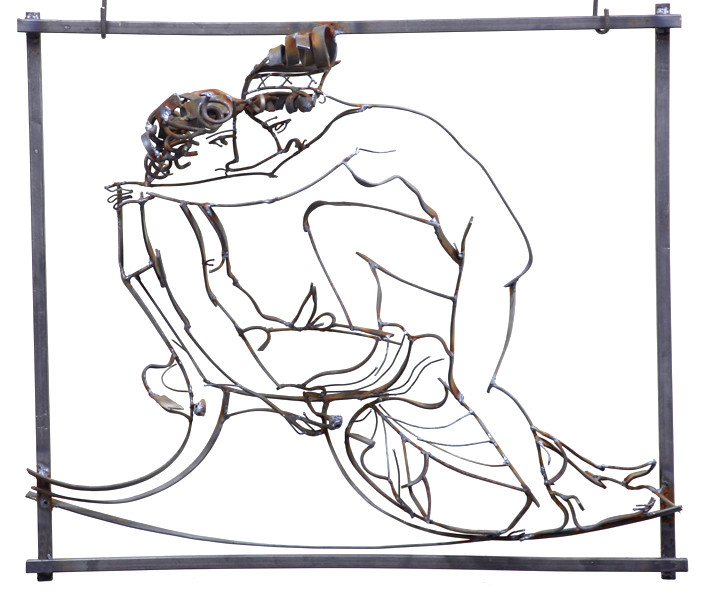
The exhibition features seven three-dimensional metal structures based on erotic scenes from ancient Greek vase paintings and Picasso’s drawings, including illustrations from Aristophanes' Lysistrata. In his interview, Dmitry Gutov explains why "Genius Needs an Orgy."
Dmitry Gutov: I remember that Balzac said this, but I can’t recall where. And, if I’m not mistaken, Mikhail Lifshits once cited this quote. Taken to its extreme, the orgy is like the beautiful phrase by Empedocles: "Love brings everything together." It’s the warmth of intimacy that a person experiences when they forget themselves and are swept up in a shared moment. This is where John Reed comes in.
Dmitry Gutov: I remember that Balzac said this, but I can’t recall where. And, if I’m not mistaken, Mikhail Lifshits once cited this quote. Taken to its extreme, the orgy is like the beautiful phrase by Empedocles: "Love brings everything together." It’s the warmth of intimacy that a person experiences when they forget themselves and are swept up in a shared moment. This is where John Reed comes in.
Oinochoya
2012–2013
Metal, welding
90 × 110 × 40 cm
2012–2013
Metal, welding
90 × 110 × 40 cm
Oinochoya
2012–2013
Metal, welding
90 × 110 × 40 cm
2012–2013
Metal, welding
90 × 110 × 40 cm
The exhibition features seven three-dimensional metal structures based on erotic scenes from ancient Greek vase paintings and Picasso’s drawings, including illustrations from Aristophanes' Lysistrata. In his interview, Dmitry Gutov explains why "Genius Needs an Orgy."
Dmitry Gutov: I remember that Balzac said this, but I can’t recall where. And, if I’m not mistaken, Mikhail Lifshits once cited this quote. Taken to its extreme, the orgy is like the beautiful phrase by Empedocles: "Love brings everything together." It’s the warmth of intimacy that a person experiences when they forget themselves and are swept up in a shared moment. This is where John Reed comes in.
Dmitry Gutov: I remember that Balzac said this, but I can’t recall where. And, if I’m not mistaken, Mikhail Lifshits once cited this quote. Taken to its extreme, the orgy is like the beautiful phrase by Empedocles: "Love brings everything together." It’s the warmth of intimacy that a person experiences when they forget themselves and are swept up in a shared moment. This is where John Reed comes in.
I can say that I was very interested in the topic of pornography during the early stages of perestroika. I was doing a project dedicated to the proverbs of the Russian people, collected by our wonderful Dahl. I can quote it. They sound like this: "Don't be surprised, Vasilisa, that four legs are entwined, otherwise you would be amazed where the fifth one went" or "In the middle ‑ in the middle, on Friday ‑ in the ass", or "Every breath loves a shove".I was very attracted to all of this, because there was a kind of erotic excitement in society that I could feel, and it ended with everything we remember and the arrival of a completely different 1990s, with the rule of different energies. And now there is a kind of return of all of this, maybe it’s from the noise of the street.

I can say that I was very interested in the topic of pornography during the early stages of perestroika. I was doing a project dedicated to the proverbs of the Russian people, collected by our wonderful Dahl. I can quote it. They sound like this: "Don't be surprised, Vasilisa, that four legs are entwined, otherwise you would be amazed where the fifth one went" or "In the middle ‑ in the middle, on Friday ‑ in the ass", or "Every breath loves a shove".I was very attracted to all of this, because there was a kind of erotic excitement in society that I could feel, and it ended with everything we remember and the arrival of a completely different 1990s, with the rule of different energies. And now there is a kind of return of all of this, maybe it’s from the noise of the street.

If I were to look for terms, I would strive for a harsh archaic. I don’t mean the way our Founding Fathers referred to crudeness and primitive iconography. I mean archaic as a whole culture that was once dismissed as hostile. Then I remembered a remarkable incident that Picasso had told me about. In the 1930s, or maybe even in the 1920s, in Paris, the Dadaists or the Surrealists would go out and walk around the streets and insult public opinion: the priests, the bourgeoisie, and they would be taken to the police station. And the only one who wasn’t taken was Joan Miró. "What were you doing, kid?" "I was walking around the streets and shouting: "Down with the Mediterranean!" "Are you crazy?" "You're attacking the consequences, but I’m attacking the cause."
If I were to look for terms, I would strive for a harsh archaic. I don’t mean the way our Founding Fathers referred to crudeness and primitive iconography. I mean archaic as a whole culture that was once dismissed as hostile. Then I remembered a remarkable incident that Picasso had told me about. In the 1930s, or maybe even in the 1920s, in Paris, the Dadaists or the Surrealists would go out and walk around the streets and insult public opinion: the priests, the bourgeoisie, and they would be taken to the police station. And the only one who wasn’t taken was Joan Miró. "What were you doing, kid?" "I was walking around the streets and shouting: "Down with the Mediterranean!" "Are you crazy?" "You're attacking the consequences, but I’m attacking the cause."
© All rights reserved.
Free admission
Daily from 11:00 AM to 8:00 PM
WE ARE OPEN
Contacts
MENU
