Free admission
Вход свободный
Daily from 11:00 AM to 8:00 PM
| Free admission
 Home
Home
globotypes
Alexey Politov
and Marina Belova
and Marina Belova
March 22 — April 7, 2013
Triumph gallery
Triumph gallery
At the exhibition by Alexey Politov and Marina Belova, the past meets the present, and the gallery space is filled with the atmosphere of tribal spirit, transforming into a sanctuary of our age.

Alexey Politov and Marina Belova have been working together since 1998, and during this time they have participated in numerous group exhibitions in Russia and abroad, while their solo exhibitions have taken place from Moscow to Berlin and Paris. The duo, Politov and Belova, explore human nature through their works, which are characterized by their use of monumental imagery. The aesthetics of cave paintings and their experiments with shadows have become a traditional aspect of their artistic practice. Nature spirits, ritual dances, hunting, love scenes, and other primitive drawings from the caves of Kazakhstan, Mongolia, and Altai, dating back to the second millennium BC, are brought to life once again in the works of these artists.
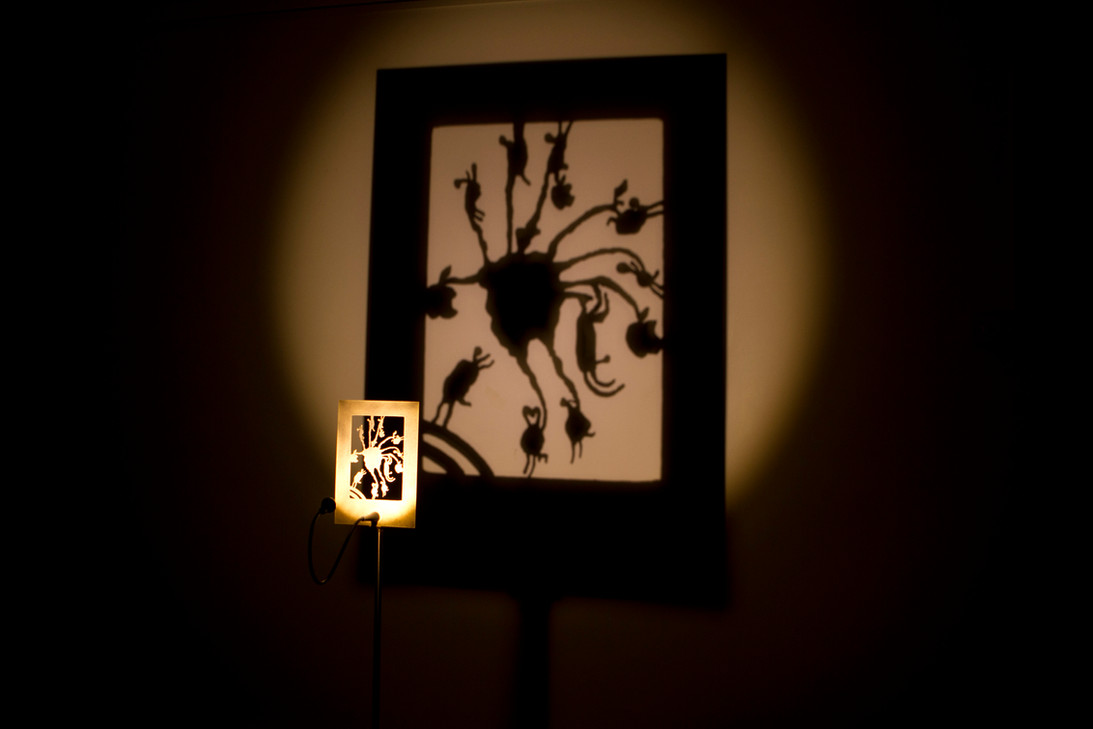
Oh, the apples
2013
Brass, metal carving, light stand
29 × 20.5 cm
2013
Brass, metal carving, light stand
29 × 20.5 cm
Oh, the apples
2013
Brass, metal carving, light stand
29 × 20.5 cm
2013
Brass, metal carving, light stand
29 × 20.5 cm
Alexey Politov and Marina Belova have been working together since 1998, and during this time they have participated in numerous group exhibitions in Russia and abroad, while their solo exhibitions have taken place from Moscow to Berlin and Paris. The duo, Politov and Belova, explore human nature through their works, which are characterized by their use of monumental imagery. The aesthetics of cave paintings and their experiments with shadows have become a traditional aspect of their artistic practice. Nature spirits, ritual dances, hunting, love scenes, and other primitive drawings from the caves of Kazakhstan, Mongolia, and Altai, dating back to the second millennium BC, are brought to life once again in the works of these artists.
In their new project, Politov and Belova address the theme of idols and taboos in modern culture with their characteristic irony. The exhibition includes a series of large-scale masks inspired by tattoos and drawings from the ancient Mayan and Maori tribes. On metal-carved icons, artists recreate real rock carvings and combine them with new idols — if you look closely, you can see the symbol of a famous gas company against the background of the image of the spirit of fire. Placed on a special illuminated stand, the icons cast a shadow on the wall, and the exhibition space turns into a theater of shadows.

In their new project, Politov and Belova address the theme of idols and taboos in modern culture with their characteristic irony. The exhibition includes a series of large-scale masks inspired by tattoos and drawings from the ancient Mayan and Maori tribes. On metal-carved icons, artists recreate real rock carvings and combine them with new idols — if you look closely, you can see the symbol of a famous gas company against the background of the image of the spirit of fire. Placed on a special illuminated stand, the icons cast a shadow on the wall, and the exhibition space turns into a theater of shadows.

The installation with metal icons refers to Chapter VII of Plato’s The State and the Myth of the Cave, where people were compared to prisoners who sit in a cave and see only vague shadows of true reality. Politov and Belova tell this myth through the example of modern human values. Mass culture, advertising, glossy print media, cinema, the fashion industry, and their offspring have become idols for billions of people. The focus has shifted to personal happiness and status, which are directly linked to the category of consumer goods. People are no longer able to break free from the imposed idols and the illusions of everyday perception.
The installation with metal icons refers to Chapter VII of Plato’s The State and the Myth of the Cave, where people were compared to prisoners who sit in a cave and see only vague shadows of true reality. Politov and Belova tell this myth through the example of modern human values. Mass culture, advertising, glossy print media, cinema, the fashion industry, and their offspring have become idols for billions of people. The focus has shifted to personal happiness and status, which are directly linked to the category of consumer goods. People are no longer able to break free from the imposed idols and the illusions of everyday perception.
© All rights reserved.
Free admission
Daily from 11:00 AM to 8:00 PM
WE ARE OPEN
Contacts
MENU
