Free admission
Вход свободный
Daily from 11:00 AM to 8:00 PM
| Free admission
 Home
Home
inner taiga
crocodilepower
November 1 — November 17, 2013
Triumph gallery
Triumph gallery
When the surrounding world turns into an exclusion zone, a personal "inner taiga" appears as an example of life-saving escapism.

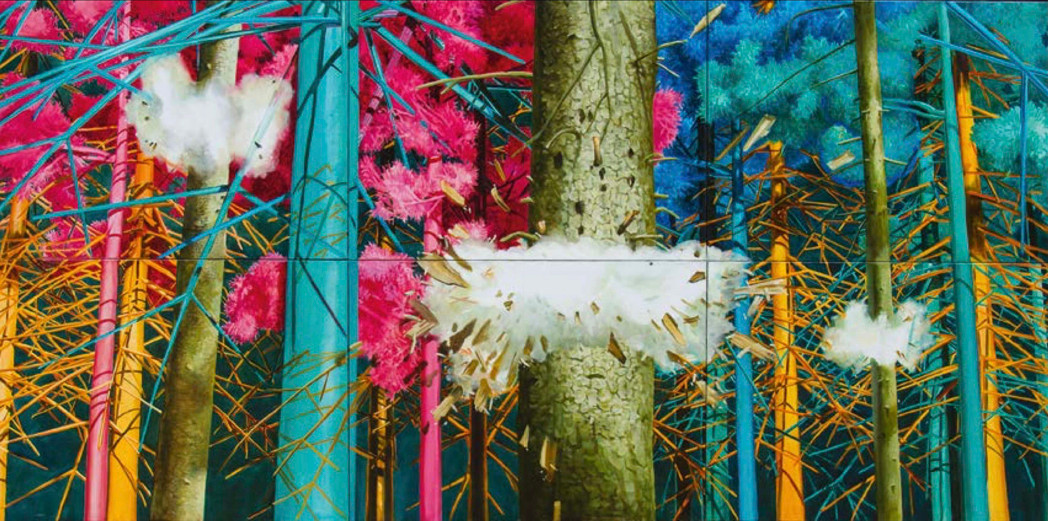
The authors of the exhibition insist that the lifestyle of modern man and the world around him have changed so much that the conditional point of no return has been passed. The main reasons for this, in their opinion, are the displacement of the natural by the technocratic and the replacement of the natural by the artificial. That’s why artists make a symbolic comeback by building their mythology, their history, and their alternate world, endowing it with characters and the relationships between them. The exhibition "Inner Taiga" is a secluded corner of the authors, woven from fabulous impressions and dreams, but which is permeated with feelings of anxious expectation and anxiety. Under the "green" decorations and declarations about saving the world, there are childishly touching experiences. They are archetypal and reveal a whole layer of mental states of modern man.
Episode 1
2013
Oil on canvas
120 × 240 cm
(6 canvases 60 × 80 cm each)
2013
Oil on canvas
120 × 240 cm
(6 canvases 60 × 80 cm each)
Episode 1
2013
Oil on canvas
120 × 240 cm
(6 canvases 60 × 80 cm each)
2013
Oil on canvas
120 × 240 cm
(6 canvases 60 × 80 cm each)
The authors of the exhibition insist that the lifestyle of modern man and the world around him have changed so much that the conditional point of no return has been passed. The main reasons for this, in their opinion, are the displacement of the natural by the technocratic and the replacement of the natural by the artificial. That’s why artists make a symbolic comeback by building their mythology, their history, and their alternate world, endowing it with characters and the relationships between them. The exhibition "Inner Taiga" is a secluded corner of the authors, woven from fabulous impressions and dreams, but which is permeated with feelings of anxious expectation and anxiety. Under the "green" decorations and declarations about saving the world, there are childishly touching experiences. They are archetypal and reveal a whole layer of mental states of modern man.
Here is an example of art in which there is no second conceptual bottom, there is no "fig in your pocket", there are no long boring explanations — there is work with the material, there is a "done" parameter. This is an art that initially appeals to sensory perception — to vision. As Francis Bacon said, "vision is the most solid and complete communication that exists." Actually, the speculative as an intermediate link or transit point is completely absent here. Any reasons for deciphering values remain on the surface and, rather, play a shading role.

Here is an example of art in which there is no second conceptual bottom, there is no "fig in your pocket", there are no long boring explanations — there is work with the material, there is a "done" parameter. This is an art that initially appeals to sensory perception — to vision. As Francis Bacon said, "vision is the most solid and complete communication that exists." Actually, the speculative as an intermediate link or transit point is completely absent here. Any reasons for deciphering values remain on the surface and, rather, play a shading role.

The Inner Taiga exhibition is the junction of the real and the virtual, a seam that hides personal experiences that have been pushed beyond the conscious. The authors do not oppose or offer any recipes for struggle, they form an impression of their inner state, like a confessional speech on the couch of a psychoanalyst. This is a dried-up emotion that makes you feel intense anxiety over and over again, and it is akin to a typical phobia of our time, generated by over-urbanization, media oppression, new communications, and all that makes up a new sociality — alien and artificial.
The Inner Taiga exhibition is the junction of the real and the virtual, a seam that hides personal experiences that have been pushed beyond the conscious. The authors do not oppose or offer any recipes for struggle, they form an impression of their inner state, like a confessional speech on the couch of a psychoanalyst. This is a dried-up emotion that makes you feel intense anxiety over and over again, and it is akin to a typical phobia of our time, generated by over-urbanization, media oppression, new communications, and all that makes up a new sociality — alien and artificial.
© All rights reserved.
Free admission
Daily from 11:00 AM to 8:00 PM
WE ARE OPEN
Contacts
MENU
