Free admission
Вход свободный
Daily from 11:00 AM to 8:00 PM
| Free admission
 Home
Home
Insecticide
Anton Kuznetsov
March 28 — April 13, 2014
Triumph gallery
Triumph gallery
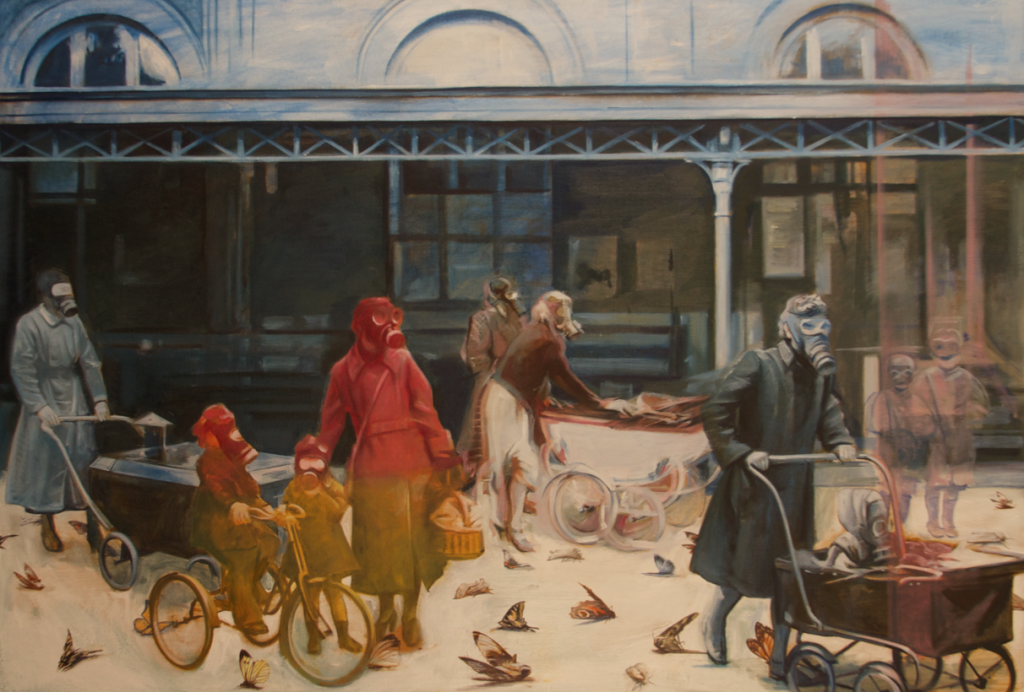
This project, from the very first glance, bewitches and perplexes. "Progressive" viewers can construct impressive associative links, either running back to Alfred Hitchcock’s The Birds or Thomas Harris/John Demme’s Silence of the Lambs. The aim of the project’s author, however, can by no means be reduced to arousing nostalgic memories of famed thrillers of the past.

The fact of the matter is that Insecticide, despite all its visual extravagance, provides a very emotional, though deeply ethical answer to the challenges of the present day. It not only demonstrates a by no means trivial point of view on the events of a hundred years ago, it also bears a powerful humanistic and pacifist charge, declaring war to be a phenomenon that, in essence, has nothing in common with human nature.
Mothers
2014
Oil on canvas
102 × 150 cm
2014
Oil on canvas
102 × 150 cm
Mothers
2014
Oil on canvas
102 × 150 cm
2014
Oil on canvas
102 × 150 cm
The fact of the matter is that Insecticide, despite all its visual extravagance, provides a very emotional, though deeply ethical answer to the challenges of the present day. It not only demonstrates a by no means trivial point of view on the events of a hundred years ago, it also bears a powerful humanistic and pacifist charge, declaring war to be a phenomenon that, in essence, has nothing in common with human nature.
All of the painted works have been created with a precise knowledge of human and zoological anatomy and a clear understanding of form (the artist graduated from the Surikov Arts Institute, and then completed his education at the Institute of Contemporary Art and at the Free Workshops of the Moscow Museum of Modern Art). Nevertheless, his original approach should be noted: in almost all of the works the imagery is either slightly blurred, as if "not in focus", or, in the colour works, either each tone is offset in the colour spectrum or the outlining of any figure has several colour contours, as if filmed in 3D but viewed without the special glasses. With these techniques, the artist appears to have almost literally infiltrated the physiology of the insects, imitating the "non-human" facets of their vision, and creating his own "alienated" position, a meta-point-of-view that provides his works with a distinct resonance.

All of the painted works have been created with a precise knowledge of human and zoological anatomy and a clear understanding of form (the artist graduated from the Surikov Arts Institute, and then completed his education at the Institute of Contemporary Art and at the Free Workshops of the Moscow Museum of Modern Art). Nevertheless, his original approach should be noted: in almost all of the works the imagery is either slightly blurred, as if "not in focus", or, in the colour works, either each tone is offset in the colour spectrum or the outlining of any figure has several colour contours, as if filmed in 3D but viewed without the special glasses. With these techniques, the artist appears to have almost literally infiltrated the physiology of the insects, imitating the "non-human" facets of their vision, and creating his own "alienated" position, a meta-point-of-view that provides his works with a distinct resonance.

The assemblages accompanying Anton Kuznetsov’s painted works are also full of military allusions and associations. The butterflies and dragonflies akin to German military planes (their wings bear the characteristic Celtic crosses), are carrying out "landings" on the epaulettes of field uniforms or on a map case with a martial order attached to it. Identical beetles are crawling in different directions across the hardened, crusted earth, or marching in good order over authentic and depersonalising "Statements from the personnel list" of a military detachment, its number on the back of each insect. These object-relics appear to be a powerful and important accompaniment to the canvases of the painter who is operating with different resources, but nevertheless operating on the same main notional dominant of Insecticide.
The assemblages accompanying Anton Kuznetsov’s painted works are also full of military allusions and associations. The butterflies and dragonflies akin to German military planes (their wings bear the characteristic Celtic crosses), are carrying out "landings" on the epaulettes of field uniforms or on a map case with a martial order attached to it. Identical beetles are crawling in different directions across the hardened, crusted earth, or marching in good order over authentic and depersonalising "Statements from the personnel list" of a military detachment, its number on the back of each insect. These object-relics appear to be a powerful and important accompaniment to the canvases of the painter who is operating with different resources, but nevertheless operating on the same main notional dominant of Insecticide.
© All rights reserved.
Free admission
Daily from 11:00 AM to 8:00 PM
WE ARE OPEN
Contacts
MENU
