Free admission
Вход свободный
Daily from 11:00 AM to 8:00 PM
| Free admission
 Home
Home
inside the surface
ustina yakovleva
June 16 — June 26, 2012
Triumph gallery
Triumph gallery
LAUNCHPAD PROJECT
As part of Triumph Gallery's Launchpad project, which showcases emerging artists, four exhibitions will be held in June. From June 16th to 26th, solo exhibitions by Ustina Yakovleva and Anastasia Zaborovskaya will be held. Curated by Vladimir Potapov.
As part of Triumph Gallery's Launchpad project, which showcases emerging artists, four exhibitions will be held in June. From June 16th to 26th, solo exhibitions by Ustina Yakovleva and Anastasia Zaborovskaya will be held. Curated by Vladimir Potapov.

Twenty-five-year-old Ustina Yakovleva completed both her art degrees—in art from Moscow State Pedagogical University and the Institute of Contemporary Art—simultaneously, which speaks to her desire to live fast. Her large solo project, "Ust-Tsilma," spectacularly opened the START platform for young art in 2010. The exhibition was rigorous, cold, and intelligent, and contained everything needed for takeoff. It stunned the Moscow art world, and Ustina became a target for scrutiny, but how can one scrutinize something impenetrable? Four months later, she prepared the project "Vacuum" for Perm (Green Art Gallery). From that moment on, Ustina became a headliner at all exhibitions of young art. "Vacuum" outlined one of her important themes: the emptiness of space, in which something speculative emerges—the observer, with their subjectivity and all the questions posed by Aristotle at the beginning of history.
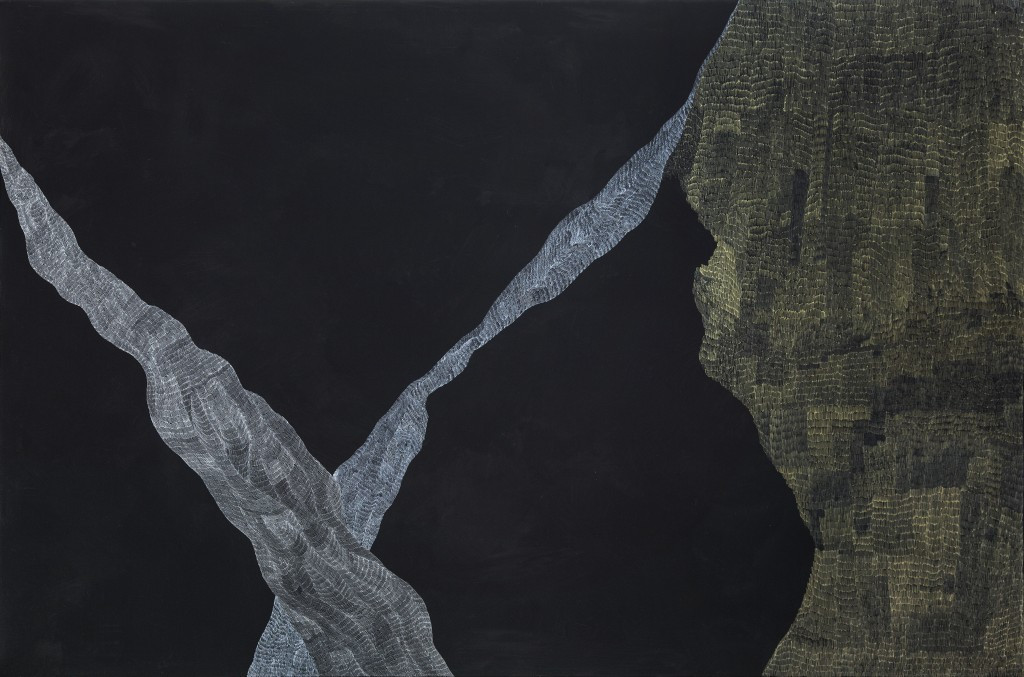
Untitled II
2012
Canvas, ink, gel pen
120 × 180 cm
2012
Canvas, ink, gel pen
120 × 180 cm
Untitled II
2012
Canvas, ink, gel pen
120 × 180 cm
2012
Canvas, ink, gel pen
120 × 180 cm
Twenty-five-year-old Ustina Yakovleva completed both her art degrees—in art from Moscow State Pedagogical University and the Institute of Contemporary Art—simultaneously, which speaks to her desire to live fast. Her large solo project, "Ust-Tsilma," spectacularly opened the START platform for young art in 2010. The exhibition was rigorous, cold, and intelligent, and contained everything needed for takeoff. It stunned the Moscow art world, and Ustina became a target for scrutiny, but how can one scrutinize something impenetrable? Four months later, she prepared the project "Vacuum" for Perm (Green Art Gallery). From that moment on, Ustina became a headliner at all exhibitions of young art. "Vacuum" outlined one of her important themes: the emptiness of space, in which something speculative emerges—the observer, with their subjectivity and all the questions posed by Aristotle at the beginning of history.
The "Inside the Surface" series is executed in ink on canvas. In painstakingly and methodically filling the blank canvas, Ustina Yakovleva finds a way to distill personal experience into art. Her friend, artist and singer Varya Pavlova-Lisokot, says of her: "In the meditative painting of graphic landscapes, Ustina Yakovleva comes to understand simple truths that proved incomprehensible, and weaves these revelations into a personal story."

The "Inside the Surface" series is executed in ink on canvas. In painstakingly and methodically filling the blank canvas, Ustina Yakovleva finds a way to distill personal experience into art. Her friend, artist and singer Varya Pavlova-Lisokot, says of her: "In the meditative painting of graphic landscapes, Ustina Yakovleva comes to understand simple truths that proved incomprehensible, and weaves these revelations into a personal story."

Her paintings are speculative, abstract, and biomorphic. She constructs a space for vision for those who cannot see beyond the conditions in which reality manifests itself. The history of the work is subject to an organic logic, imbued with its own physiology. This dictates the development of form and its unfolding in space. Space is located within the surface. She constructs compositions as a documentation of the gaze’s movement in space and, simultaneously, the result of this movement. Space opens up to the touch, to the artist’s hand. The gaze, the hand, the surface, and the imaginary landscape within it all converge in a shared event. The painting becomes a testimony of this meeting.
Her paintings are speculative, abstract, and biomorphic. She constructs a space for vision for those who cannot see beyond the conditions in which reality manifests itself. The history of the work is subject to an organic logic, imbued with its own physiology. This dictates the development of form and its unfolding in space. Space is located within the surface. She constructs compositions as a documentation of the gaze’s movement in space and, simultaneously, the result of this movement. Space opens up to the touch, to the artist’s hand. The gaze, the hand, the surface, and the imaginary landscape within it all converge in a shared event. The painting becomes a testimony of this meeting.
© All rights reserved.
Free admission
Daily from 11:00 AM to 8:00 PM
WE ARE OPEN
Contacts
MENU
