Free admission
Вход свободный
Daily from 11:00 AM to 8:00 PM
| Free admission
 Home
Home
intersections
Dmitry okruzhnov & Marina sharova
November 1 — November 17, 2013
Triumph gallery
Triumph gallery
"Don't be afraid, it’s not true, everything’s fine," was what many adults told their children on January 28, 1986, as they watched the Challenger spacecraft crash live on the air.

It was the first ever live broadcast of a space launch. The effect of the presence provided by the live broadcast allowed the audience of millions to feel their involvement, and the more dramatic were the consequences of what they saw. This is McLuhan’s prophecy that has come true — the "global village" has become a common place, its structure is gaining clearer contours, density and its own special sociality every day. The emergence of media reality gave rise to media culture, its redundancy gave rise to information garbage, which, in turn, becomes both the subject of research and the artistic resource of the exhibition’s authors, Maria Sharova and Dmitry Okruzhnov.
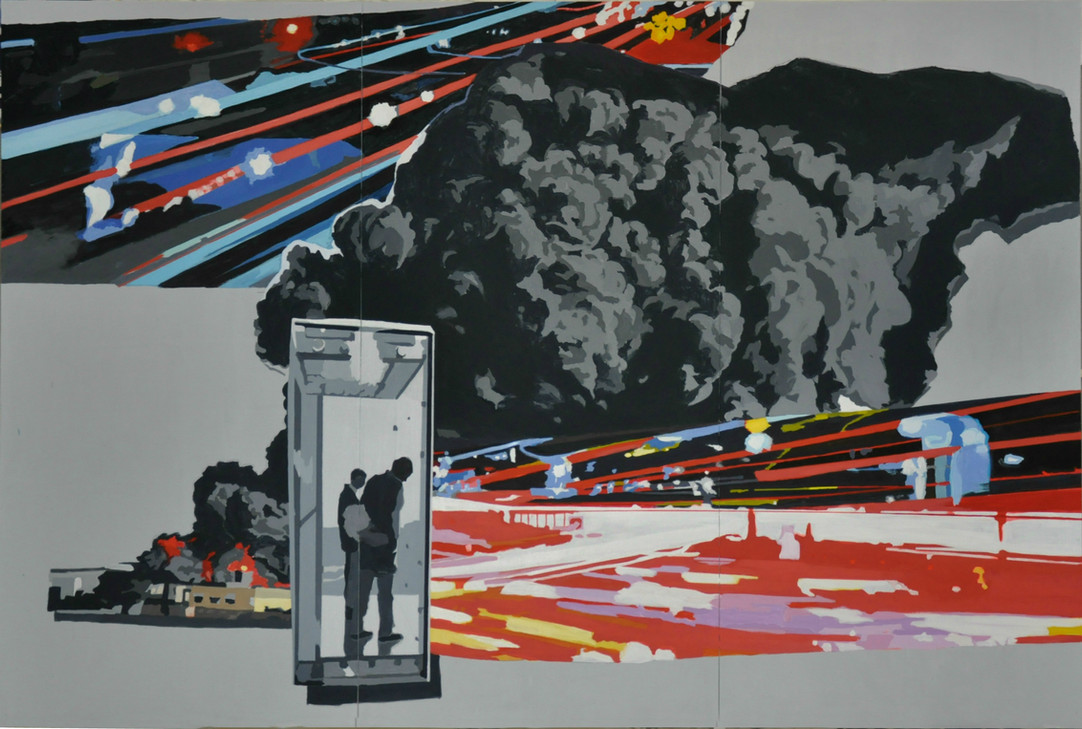
Detachment
2013
Canvas, acrylic
260 × 400 cm
2013
Canvas, acrylic
260 × 400 cm
Detachment
2013
Canvas, acrylic
260 × 400 cm
2013
Canvas, acrylic
260 × 400 cm
It was the first ever live broadcast of a space launch. The effect of the presence provided by the live broadcast allowed the audience of millions to feel their involvement, and the more dramatic were the consequences of what they saw. This is McLuhan’s prophecy that has come true — the "global village" has become a common place, its structure is gaining clearer contours, density and its own special sociality every day. The emergence of media reality gave rise to media culture, its redundancy gave rise to information garbage, which, in turn, becomes both the subject of research and the artistic resource of the exhibition’s authors, Maria Sharova and Dmitry Okruzhnov.
History knows many examples when artists paint visionary paintings, this quality has long been considered an indisputable advantage of the work. In this sense, the authors are far from prophecies and predictions, they tend to have an empirical view. They capture the daily kaleidoscope of media events and choose only those that resonate with their own worldview, and it is quite textbook apocalyptic. In some places, one can notice a thanatophilic orientation, which is manifested in plots with death or in its consequences.

History knows many examples when artists paint visionary paintings, this quality has long been considered an indisputable advantage of the work. In this sense, the authors are far from prophecies and predictions, they tend to have an empirical view. They capture the daily kaleidoscope of media events and choose only those that resonate with their own worldview, and it is quite textbook apocalyptic. In some places, one can notice a thanatophilic orientation, which is manifested in plots with death or in its consequences.

The artists offer the viewer the look of an observer who is speeding through urban streets and road junctions. It is located in those high-speed units, whose fragments are so carefully painted by artists. Using the collage technique, the authors record two times: the moment before the catastrophe, that is, the last thing that was imprinted on the retina of the eye, and the moment immediately after it, thereby revealing the nonlinear narrative in the picture, as a broadcast of the same place from different cameras and at different times. The artists reveal the impetuosity of time through the fixation of media space, its multi-layered movement, where the painting, as an example of universal media, understandable to most, absorbs the puzzles of everyday life and rehabilitates itself as a kind of security console display.
Curator:
Vladimir Potapov
Curator:
Vladimir Potapov
The artists offer the viewer the look of an observer who is speeding through urban streets and road junctions. It is located in those high-speed units, whose fragments are so carefully painted by artists. Using the collage technique, the authors record two times: the moment before the catastrophe, that is, the last thing that was imprinted on the retina of the eye, and the moment immediately after it, thereby revealing the nonlinear narrative in the picture, as a broadcast of the same place from different cameras and at different times. The artists reveal the impetuosity of time through the fixation of media space, its multi-layered movement, where the painting, as an example of universal media, understandable to most, absorbs the puzzles of everyday life and rehabilitates itself as a kind of security console display.
Curator:
Vladimir Potapov
Curator:
Vladimir Potapov
© All rights reserved.
Free admission
Daily from 11:00 AM to 8:00 PM
WE ARE OPEN
Contacts
MENU
