Free admission
Вход свободный
Daily from 11:00 AM to 8:00 PM
| Free admission
 Home
Home
miracles
Alex Folla
February 18 — March 2, 2014
Triumph gallery
Triumph gallery
In what mysterious recesses of everyday life is nowadays the elusive concept of "holiness" hidden?

And above all: will we still be able to recognize a Saint — a real Saint — behind the opaque mirrors of the small and miserable actions every day, if we happened to face him, or have the complex dynamics of the consumer society, the materialism now prevailing everywhere and constantly, the growing tendency to be turned into a spectacular event enveloping every aspect of daily life, the lack of spiritual elements to be used as a reference point, the difficulty in seeing and recognizing an unexpected event unknowable except through a true act of faith (what was once known as the a "miracle", a word today fatally fallen into disused), finally and irretrievably deprived us of the ability not only to believe, but also, and even, to see?
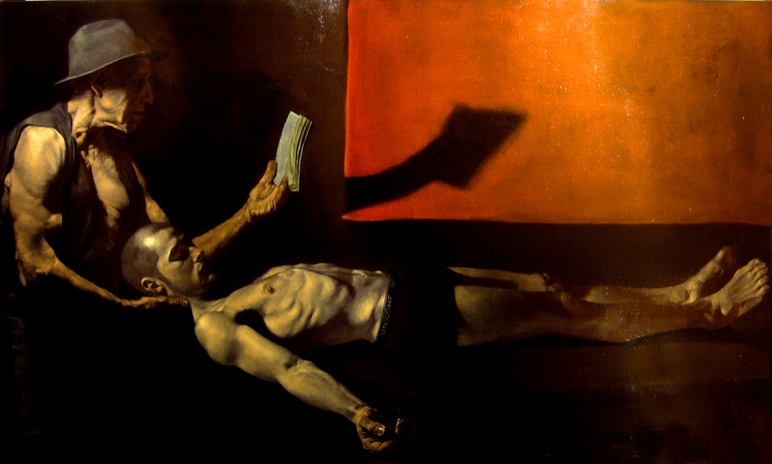
Dismas
2012
Oil paint, lacquer, bitumen, glue on canvas
160 × 92 cm
2012
Oil paint, lacquer, bitumen, glue on canvas
160 × 92 cm
Dismas
2012
Oil paint, lacquer, bitumen, glue on canvas
160 × 92 cm
2012
Oil paint, lacquer, bitumen, glue on canvas
160 × 92 cm
And above all: will we still be able to recognize a Saint — a real Saint — behind the opaque mirrors of the small and miserable actions every day, if we happened to face him, or have the complex dynamics of the consumer society, the materialism now prevailing everywhere and constantly, the growing tendency to be turned into a spectacular event enveloping every aspect of daily life, the lack of spiritual elements to be used as a reference point, the difficulty in seeing and recognizing an unexpected event unknowable except through a true act of faith (what was once known as the a "miracle", a word today fatally fallen into disused), finally and irretrievably deprived us of the ability not only to believe, but also, and even, to see?
Alex Folla looks for his heroes, or antiheroes, in the faces and gestures of "normal" and common suffering men and old people (one of which, whose face is as dignified, stern and ancient as it had been carved in stone, has the appearance of his father, who passed away recently after a long illness);

Alex Folla looks for his heroes, or antiheroes, in the faces and gestures of "normal" and common suffering men and old people (one of which, whose face is as dignified, stern and ancient as it had been carved in stone, has the appearance of his father, who passed away recently after a long illness);

he looks for them in everyday life, as if to revive, in the bare and poetic sanctity of his dark backgrounds and his lightning of grazing light in the style of Caravaggio, the magnificence of the "cinema of poetry" whose master in Italy was Pier Paolo Pasolini: and just as Pasolini went in search of his gods, his Greek heroes and his apostles in the faces and gestures of the boys and men he went to track down in the outskirts and in the countryside of Lazio or on the dusty roads of southern Italy, today Folla too goes in search of his contemporary saints in the least predictable places and, somehow, the most human than could ever exist on earth: bedrooms of patients and sick people, nursing homes, roads and fields from a time that seems to have stopped in a pre-modern civilization, frozen in an era that seems to have no yet known the flattening effect of globalization and the loss of sense of contemporaneity (it should be noted that already Caravaggio, in his time, used — as is known — to go in search of models for his sacred paintings among prostitutes, alcoholics and little street urchins).
he looks for them in everyday life, as if to revive, in the bare and poetic sanctity of his dark backgrounds and his lightning of grazing light in the style of Caravaggio, the magnificence of the "cinema of poetry" whose master in Italy was Pier Paolo Pasolini: and just as Pasolini went in search of his gods, his Greek heroes and his apostles in the faces and gestures of the boys and men he went to track down in the outskirts and in the countryside of Lazio or on the dusty roads of southern Italy, today Folla too goes in search of his contemporary saints in the least predictable places and, somehow, the most human than could ever exist on earth: bedrooms of patients and sick people, nursing homes, roads and fields from a time that seems to have stopped in a pre-modern civilization, frozen in an era that seems to have no yet known the flattening effect of globalization and the loss of sense of contemporaneity (it should be noted that already Caravaggio, in his time, used — as is known — to go in search of models for his sacred paintings among prostitutes, alcoholics and little street urchins).
© All rights reserved.
Free admission
Daily from 11:00 AM to 8:00 PM
WE ARE OPEN
Contacts
MENU
