Free admission
Вход свободный
Daily from 11:00 AM to 8:00 PM
| Free admission
 Home
Home
new mythology
Olga Tobreluts
January 24 — February 24, 2013
Moscow Museum of Modern Art
Moscow Museum of Modern Art
Moscow Museum of Modern Art, with the support of the Triumph Gallery, presents a large-scale retrospective exhibition by Olga Tobreluts, who gained international fame primarily as a pioneer of media art and the author of large-scale video installations. Having been one of the first to turn to modern computer technologies, Olga Tobreluts already in her early works came to her own unique and very recognizable style. Tobreluts' paintings are complex manipulations of historical reality and myths of modern culture, fused together and transformed into a magical super-reality.

In the early 90s, in the "Models" series, the artist "revives" antique statues, giving them photographically authentic and flawless bodies, and dressing them up in clothes from fashion brands. This series receives the first GRIFFELKUNST prize together with the artist Orlan for the best European computer graphics. In 1999, at the exhibition "Heaven" in TATA, she shows a new series "Sacred Figures", in which ancient portraits get new faces. Her works gain international fame, appear on the covers of such magazines and newspapers as ART, ATTITUDE, Dusseldorf Hefte, The Observer Magazine and many others, and receive international prizes. In 2000, Olga began work on a grandiose project — a series of 54 works "Caesar and the Galilean" based on the drama of the same name by Heinrich Ibsen, which was exhibited at the Henie Onstad Museum in Oslo, and then at the Russian Museum in St. Petersburg.
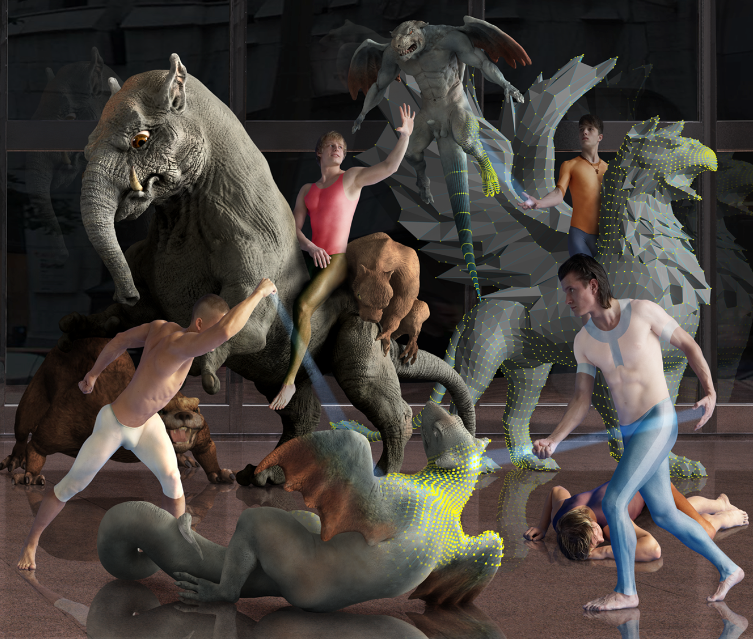
Modernization
2002-2012
Oil on canvas
145 × 170 cm
2002-2012
Oil on canvas
145 × 170 cm
Modernization
2002-2012
Oil on canvas
145 × 170 cm
2002-2012
Oil on canvas
145 × 170 cm
In the early 90s, in the "Models" series, the artist "revives" antique statues, giving them photographically authentic and flawless bodies, and dressing them up in clothes from fashion brands. This series receives the first GRIFFELKUNST prize together with the artist Orlan for the best European computer graphics. In 1999, at the exhibition "Heaven" in TATA, she shows a new series "Sacred Figures", in which ancient portraits get new faces. Her works gain international fame, appear on the covers of such magazines and newspapers as ART, ATTITUDE, Dusseldorf Hefte, The Observer Magazine and many others, and receive international prizes. In 2000, Olga began work on a grandiose project — a series of 54 works "Caesar and the Galilean" based on the drama of the same name by Heinrich Ibsen, which was exhibited at the Henie Onstad Museum in Oslo, and then at the Russian Museum in St. Petersburg.
Since 2003, Olga has almost completely stopped working with a computer and returned to painting. Turning to ancient painting techniques, she manages to find her painting style, which she develops while experimenting with chemical compositions of paints to expand the pictorial possibilities of light transmission.

Since 2003, Olga has almost completely stopped working with a computer and returned to painting. Turning to ancient painting techniques, she manages to find her painting style, which she develops while experimenting with chemical compositions of paints to expand the pictorial possibilities of light transmission.

The MMOMA retrospective will bring together not only famous series and individual works by the artist from a number of museum and private collections, but also for the first time show her experimental works. The curator of the exhibition, Antonio Geusa, is an independent critic and curator, an expert in the field of art of new technologies, a researcher of Russian video art, the author of a number of publications, including the catalog for the three-part project of the same name at MMOMA "The History of Russian Video Art" (2007 — 2010).
The MMOMA retrospective will bring together not only famous series and individual works by the artist from a number of museum and private collections, but also for the first time show her experimental works. The curator of the exhibition, Antonio Geusa, is an independent critic and curator, an expert in the field of art of new technologies, a researcher of Russian video art, the author of a number of publications, including the catalog for the three-part project of the same name at MMOMA "The History of Russian Video Art" (2007 — 2010).
© All rights reserved.
Free admission
Daily from 11:00 AM to 8:00 PM
WE ARE OPEN
Contacts
MENU
