Free admission
Вход свободный
Daily from 11:00 AM to 8:00 PM
| Free admission
 Home
Home
partly cloudy
Alexandra Vertinskaya
December 15, 2012 — January 27, 2013
Triumph gallery
Triumph gallery
Paradoxically, the only truly modern artist can be called an artist who is not distracted by momentary stimuli, has the strength not to follow fashion and conjuncture, someone who boldly stirs up the plots of the past and images of the future in the present of the painting. To shake up, but not confuse, the past with the future is the recipe for the mathematical point of view of the present, according to which creation reveals its ontological status. Otherwise, oblivion, since any discourse is fraught with its own destruction. As Prigov’s "militiaman," she doesn’t hide, and this memento mori, adopted by popular culture, is extremely tempting for many.

The difference between an intellectual and an intellectual, an artist from an illustrator, a creative person from a creative operator lies in a certain contempt for the prevailing discourse. You can only talk to Time on equal terms. This, and only this, was what Beuys meant when he declared, "Every man is an artist." And it’s hard to be human.
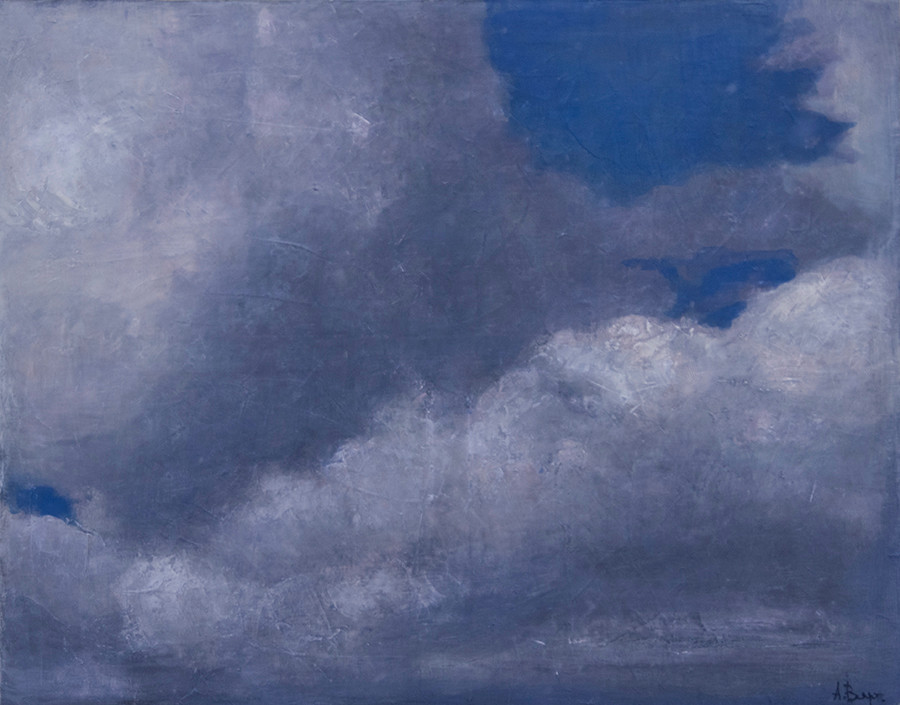
Altered consciousness
2012
Canvas, acrylic
110 × 140 cm
2012
Canvas, acrylic
110 × 140 cm
Altered consciousness
2012
Canvas, acrylic
110 × 140 cm
2012
Canvas, acrylic
110 × 140 cm
The difference between an intellectual and an intellectual, an artist from an illustrator, a creative person from a creative operator lies in a certain contempt for the prevailing discourse. You can only talk to Time on equal terms. This, and only this, was what Beuys meant when he declared, "Every man is an artist." And it’s hard to be human.
Alexandra Vertinskaya’s "too human" detachment is characteristic of her painting to the same extent as for her teacher Yuri Cooper, in whose Paris studio she studied for several years. However, for both of them, painting means more than canvas/oil. New media do not take technology beyond the boundaries prescribed by history and material, but expand the possibilities of painting, a unique reflection of iconic reality.

Alexandra Vertinskaya’s "too human" detachment is characteristic of her painting to the same extent as for her teacher Yuri Cooper, in whose Paris studio she studied for several years. However, for both of them, painting means more than canvas/oil. New media do not take technology beyond the boundaries prescribed by history and material, but expand the possibilities of painting, a unique reflection of iconic reality.

Silk-screen printing, expropriated by pop art half a century ago, for Vertinskaya serves not as a means of inflation (as for Warhol), but as a means of reifying the image, literally filling it with the material substance of paint. In Vertinskaya’s exhibition "Willows and Olives" (Triumph, 2008), an autobiographical image (a photograph is a part of the soul reflected in the silver retina of a camera) is stripped of its individual features in the process of being pressed through a silkscreen screen in order to expose the archetypal in streaks of printing ink, as in the rustle of discarded clothes, and merge into mystical ecstasy with the fauna, which is alien to the narrative.
Silk-screen printing, expropriated by pop art half a century ago, for Vertinskaya serves not as a means of inflation (as for Warhol), but as a means of reifying the image, literally filling it with the material substance of paint. In Vertinskaya’s exhibition "Willows and Olives" (Triumph, 2008), an autobiographical image (a photograph is a part of the soul reflected in the silver retina of a camera) is stripped of its individual features in the process of being pressed through a silkscreen screen in order to expose the archetypal in streaks of printing ink, as in the rustle of discarded clothes, and merge into mystical ecstasy with the fauna, which is alien to the narrative.
© All rights reserved.
Free admission
Daily from 11:00 AM to 8:00 PM
WE ARE OPEN
Contacts
MENU
