Free admission
Вход свободный
Daily from 11:00 AM to 8:00 PM
| Free admission
 Home
Home
pool for fishing
Alexey Vasiliev
September 4 — September 15, 2013
Triumph gallery
Triumph gallery
Alexey Vasiliev is a bright and original artist from Kaluga, who has already participated in many major exhibition projects. Vasiliev’s works were presented at the biennale of young art "Stop! Who’s Coming?" in 2006, 2008, and 2012, and at Moscow’s main cultural venues — the Artplay Design Center, the Vinzavod Design Center, the Moscow Museum of Modern Art, and others. The artist’s exhibitions were also held in Lisbon, the United Arab Emirates, Basel and New York. Alexey Vasiliev will present a new exhibition project "Pool for Fishing" at the Triumph Gallery, a series of paintings on canvas and concrete.

Vladimir Potapov, curator, artist, notes: "Vasiliev refers to the tradition of neo-Expressionism, he is a follower of the very "bad painting", its foundations, but with one caveat. He does not choose or borrow this language from among the possible ones, it is his native language. This clumping is typical for authors who "live by it," it’s not a language game, but rather a characterization." Vasiliev creates images through which the artist’s complex and sometimes mystical worldview emerges. The obvious literariness of the work does not reduce it to the status of an illustration, but it becomes a necessary link between the viewer and Vasiliev’s mythology.
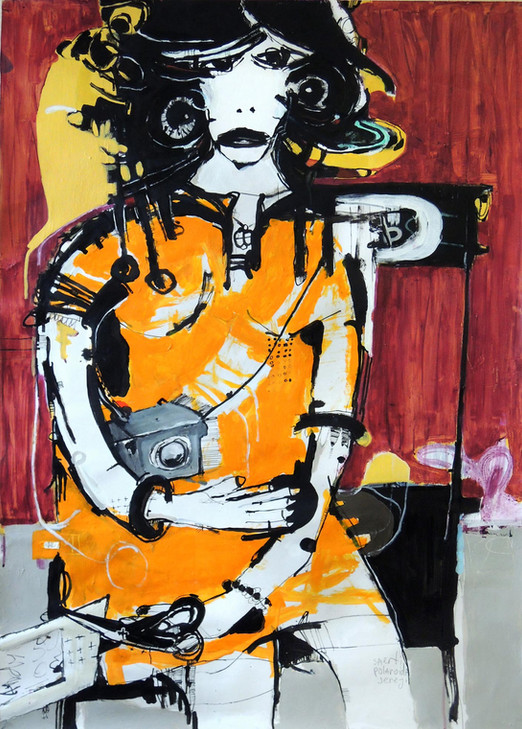
Cutting the polaroid
2012
Paper, acrylic, ink, pencil
86 × 120 cm
2012
Paper, acrylic, ink, pencil
86 × 120 cm
Cutting the polaroid
2012
Paper, acrylic, ink, pencil
86 × 120 cm
2012
Paper, acrylic, ink, pencil
86 × 120 cm
Vladimir Potapov, curator, artist, notes: "Vasiliev refers to the tradition of neo-Expressionism, he is a follower of the very "bad painting", its foundations, but with one caveat. He does not choose or borrow this language from among the possible ones, it is his native language. This clumping is typical for authors who "live by it," it’s not a language game, but rather a characterization." Vasiliev creates images through which the artist’s complex and sometimes mystical worldview emerges. The obvious literariness of the work does not reduce it to the status of an illustration, but it becomes a necessary link between the viewer and Vasiliev’s mythology.
"My father used to buy frozen carp and throw them into the pool. At night, under the moon, the tattoo "Fish's not dead" glittered on his back; "They were fishing at great depths in the Yellow Sea. At the singing lesson, they were told that music is heard there in a different way — not through the ears. And both of them, being deaf, believed that the fish would teach them to listen." The stories collected and invented by the artist for the exhibition tell about the relationships of people for whom fish has become a way to achieve an important goal.

"My father used to buy frozen carp and throw them into the pool. At night, under the moon, the tattoo "Fish's not dead" glittered on his back; "They were fishing at great depths in the Yellow Sea. At the singing lesson, they were told that music is heard there in a different way — not through the ears. And both of them, being deaf, believed that the fish would teach them to listen." The stories collected and invented by the artist for the exhibition tell about the relationships of people for whom fish has become a way to achieve an important goal.

The exhibition will also include the artist’s works on concrete and a series of portraits.
The exhibition will also include the artist’s works on concrete and a series of portraits.
© All rights reserved.
Free admission
Daily from 11:00 AM to 8:00 PM
WE ARE OPEN
Contacts
MENU
