Free admission
Вход свободный
Daily from 11:00 AM to 8:00 PM
| Free admission
 Home
Home
relicts
Lily Idova
June 28 — July 14, 2013
Triumph gallery
Triumph gallery
That’s what Lily Idova called her debut exhibition.

Once upon a time, this magic word caused a rush of joy, almost euphoria, in a Soviet schoolboy. It promised a visit to the paleontological museum with its wonderful fossil creatures and stuffed dinosaurs. Many years later, skeletons in closets began to be associated with unpleasant adult finds, and the feeling of overwhelming delight from encountering the unknown faded along with the museums themselves.
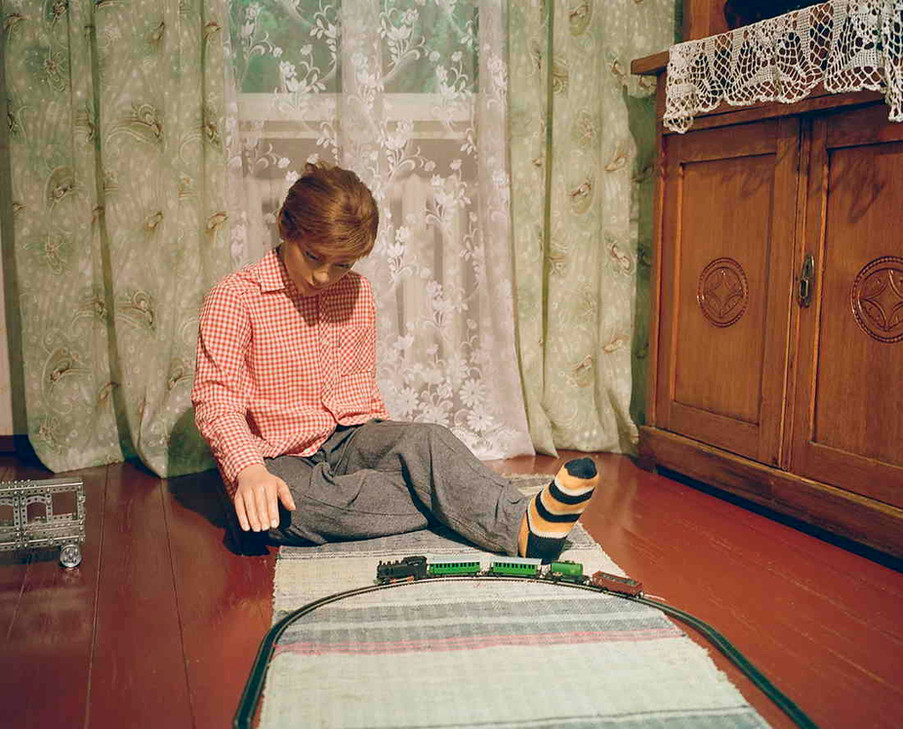
Boy. Moscow Railway Museum
2013
Inkjet printing on paper
Hahnemühle FineArt Pearl
40 × 50 cm
2013
Inkjet printing on paper
Hahnemühle FineArt Pearl
40 × 50 cm
Boy. Moscow Railway Museum
2013
Inkjet printing on paper
Hahnemühle FineArt Pearl
40 × 50 cm
2013
Inkjet printing on paper
Hahnemühle FineArt Pearl
40 × 50 cm
Once upon a time, this magic word caused a rush of joy, almost euphoria, in a Soviet schoolboy. It promised a visit to the paleontological museum with its wonderful fossil creatures and stuffed dinosaurs. Many years later, skeletons in closets began to be associated with unpleasant adult finds, and the feeling of overwhelming delight from encountering the unknown faded along with the museums themselves.
The amazing combination of perspectives, the crossing, the intersection of children’s and adult views is one of the main features of this project. Let’s take the subjects themselves. All these outlandish exhibits, such as stuffed dogs of various breeds or the figure of Sergei Korolev, who looks like Hollywood superman, at his desk, as well as monumental pre-revolutionary cabinets and dirty, glittering showcases, archaic exhibition spaces and echoing halls filled with battered furniture, were shot in more than two dozen Moscow museums. These meetings are rarely attended by the capital’s art beau monde and practically do not come to the attention of critics, unless the Voina group decides to do another action here. Some of them — like the Darwin and Polytechnic museums, the museums of cosmonautics, geology, mineralogy or the Battle of Borodino panorama — are the patrimony of children going on a Sunday nature exploration trip hand in hand with their parents tired of the working week. The other is catering, electrification, or water supply museums, which are industry expositions of interest to narrow specialists or created for the sake of a bureaucratic checkmark; many of them are dreary to the point of dread.

The amazing combination of perspectives, the crossing, the intersection of children’s and adult views is one of the main features of this project. Let’s take the subjects themselves. All these outlandish exhibits, such as stuffed dogs of various breeds or the figure of Sergei Korolev, who looks like Hollywood superman, at his desk, as well as monumental pre-revolutionary cabinets and dirty, glittering showcases, archaic exhibition spaces and echoing halls filled with battered furniture, were shot in more than two dozen Moscow museums. These meetings are rarely attended by the capital’s art beau monde and practically do not come to the attention of critics, unless the Voina group decides to do another action here. Some of them — like the Darwin and Polytechnic museums, the museums of cosmonautics, geology, mineralogy or the Battle of Borodino panorama — are the patrimony of children going on a Sunday nature exploration trip hand in hand with their parents tired of the working week. The other is catering, electrification, or water supply museums, which are industry expositions of interest to narrow specialists or created for the sake of a bureaucratic checkmark; many of them are dreary to the point of dread.

About 50 large—format prints grouped into sections are a real research project of "slow photography", designed to make visible the backbone of modernity, hidden under the layers of time and the sugar shell of ideology. It is easy to see traces of creatively reinterpreted artistic influences and major discussions of our time, whether it is a dialogue about the "living and dead" museum space or the idea of visualizing the unnoticed or carefully hidden.
About 50 large—format prints grouped into sections are a real research project of "slow photography", designed to make visible the backbone of modernity, hidden under the layers of time and the sugar shell of ideology. It is easy to see traces of creatively reinterpreted artistic influences and major discussions of our time, whether it is a dialogue about the "living and dead" museum space or the idea of visualizing the unnoticed or carefully hidden.
© All rights reserved.
Free admission
Daily from 11:00 AM to 8:00 PM
WE ARE OPEN
Contacts
MENU
