Free admission
Вход свободный
Daily from 11:00 AM to 8:00 PM
| Free admission
 Home
Home
SUSTAINABILITY
Rikuji Makabe
September 7 — September 26, 2012
Triumph gallery
Triumph gallery
Japanese artist Rikuji Makabe was born in Kanazawa in 1971. After graduating from the Tama Institute of Art (Tokyo) in 1998, Makabe actively participates in exhibitions and collaborates with a number of Japanese and foreign galleries.

Rikuji Makabe works in oil on canvas and wood, and also experiments with street art. For the Setouchi International Festival, Makabe made his first works on the walls of Japanese houses using traditional cashew-based paints. "I explored the interaction of paintings with the surrounding world and nature, which allowed me to expand the possibilities of artistic language," says the artist.
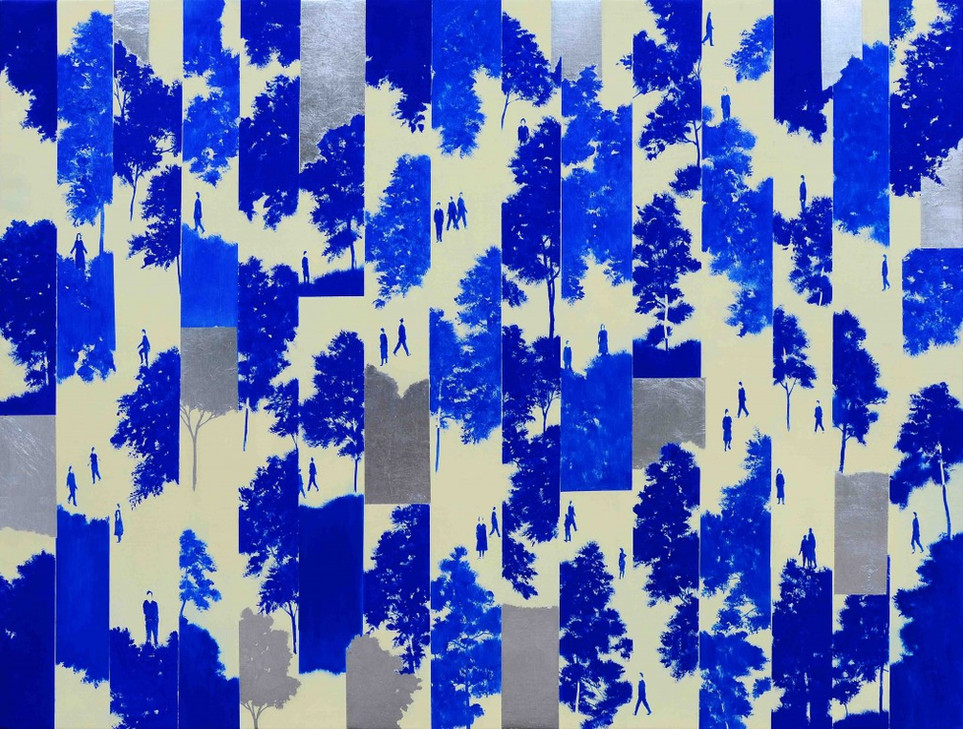
Forgotten memories
2012
Oil on canvas, aluminum sheets
112.0 × 146 cm
2012
Oil on canvas, aluminum sheets
112.0 × 146 cm
Forgotten memories
2012
Oil on canvas, aluminum sheets
112.0 × 146 cm
2012
Oil on canvas, aluminum sheets
112.0 × 146 cm
Rikuji Makabe works in oil on canvas and wood, and also experiments with street art. For the Setouchi International Festival, Makabe made his first works on the walls of Japanese houses using traditional cashew-based paints. "I explored the interaction of paintings with the surrounding world and nature, which allowed me to expand the possibilities of artistic language," says the artist.
In Makabe’s works, rhythmically repeating silhouettes of trees alternate with bright planes of pure color. Upon closer examination, hidden human figures can be discovered in the detailed landscape, thus the viewer travels through a maze of elusive images and vivid combinations.

In Makabe’s works, rhythmically repeating silhouettes of trees alternate with bright planes of pure color. Upon closer examination, hidden human figures can be discovered in the detailed landscape, thus the viewer travels through a maze of elusive images and vivid combinations.

Using expressive techniques, Rikuji Makabe draws on the traditions of Japanese painting. In some of Macabe’s paintings, the landscape is presented from above, which gives the viewer the feeling of flying. Using this technique, he pays tribute to the tradition of Rakutyu-Rakugai, a series of images of Kyoto and its surroundings, the first of which date back to the 16th century. His works are also reminiscent of ornamental art — the color combinations found in Kutani ceramics. Macabe transforms shapes and backgrounds, building the composition of an image in relation to its parts. Macabe’s works, on the one hand, are carefully drawn, on the other — free of detail, seem to be a bridge between this and other worlds.
Using expressive techniques, Rikuji Makabe draws on the traditions of Japanese painting. In some of Macabe’s paintings, the landscape is presented from above, which gives the viewer the feeling of flying. Using this technique, he pays tribute to the tradition of Rakutyu-Rakugai, a series of images of Kyoto and its surroundings, the first of which date back to the 16th century. His works are also reminiscent of ornamental art — the color combinations found in Kutani ceramics. Macabe transforms shapes and backgrounds, building the composition of an image in relation to its parts. Macabe’s works, on the one hand, are carefully drawn, on the other — free of detail, seem to be a bridge between this and other worlds.
© All rights reserved.
Free admission
Daily from 11:00 AM to 8:00 PM
WE ARE OPEN
Contacts
MENU
