Free admission
Вход свободный
Daily from 11:00 AM to 8:00 PM
| Free admission
 Home
Home
end of the world
Leonid Rotar
November 16 — November 28, 2012
Triumph gallery
Triumph gallery
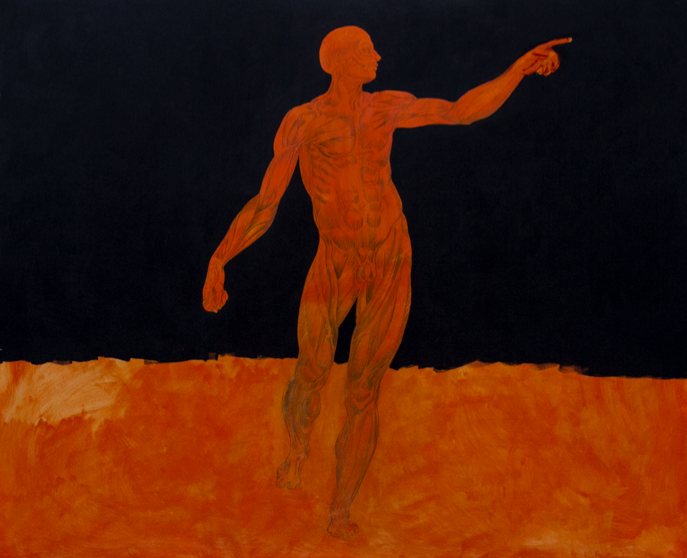
Leonid Rotar’s exhibition "THE END OF THE WORLD", united by the topical theme of the apocalypse, will open in the Triumph Gallery.

For the first time in a long time, Leonid Rotar’s solo exhibition will be held, which includes works from his large series made over the past ten years, as well as new paintings showing a world on the verge of extinction.
Recalculation
2012
Oil on canvas
180 × 220 cm
2012
Oil on canvas
180 × 220 cm
Recalculation
2012
Oil on canvas
180 × 220 cm
2012
Oil on canvas
180 × 220 cm
For the first time in a long time, Leonid Rotar’s solo exhibition will be held, which includes works from his large series made over the past ten years, as well as new paintings showing a world on the verge of extinction.
The works are executed in an ascetic manner characteristic of the artist with a minimum of details and focus on the human figure, as if caught off guard by the camera lens. The end of the world, as seen by Rotary, is far from the scenes of the raging natural elements in the spirit of Bryullov, which have become a pictorial cliche in the long history of waiting for the end of mankind. There is also no accusatory morality with violent images typical of Bosch or Goya. The artist’s view of the world-old theme is very modern, offering a psychological experience rather than a contemplative one.

The works are executed in an ascetic manner characteristic of the artist with a minimum of details and focus on the human figure, as if caught off guard by the camera lens. The end of the world, as seen by Rotary, is far from the scenes of the raging natural elements in the spirit of Bryullov, which have become a pictorial cliche in the long history of waiting for the end of mankind. There is also no accusatory morality with violent images typical of Bosch or Goya. The artist’s view of the world-old theme is very modern, offering a psychological experience rather than a contemplative one.

Like Hitchcock’s films, inner excitement and inexplicable anxiety are conveyed to the viewer by carefully selected techniques: the oppressive dark background of huge, human-sized canvases, clocks stopped at zero, a naked landscape more reminiscent of the moon, or a cross, either church or grave. All this creates a feeling of ringing silence and complete loneliness. And what could be worse for such a social being as a human being? Rotar chose children and teenagers as the main characters of his apocalyptic plot, whose pale, slender bodies with ominously empty eyes sometimes appear timidly, and sometimes in unconscious glee against the background of darkness. Designed to represent the future, childhood in Leonid Rotar’s works takes on the color of the inevitable end of civilization, when the world, abandoned by adults, left no support for further existence. The "end of the world" crosses the boundaries of not so much physical as moral destruction, after which there remains only a feeling of emptiness and hopelessness.
Like Hitchcock’s films, inner excitement and inexplicable anxiety are conveyed to the viewer by carefully selected techniques: the oppressive dark background of huge, human-sized canvases, clocks stopped at zero, a naked landscape more reminiscent of the moon, or a cross, either church or grave. All this creates a feeling of ringing silence and complete loneliness. And what could be worse for such a social being as a human being? Rotar chose children and teenagers as the main characters of his apocalyptic plot, whose pale, slender bodies with ominously empty eyes sometimes appear timidly, and sometimes in unconscious glee against the background of darkness. Designed to represent the future, childhood in Leonid Rotar’s works takes on the color of the inevitable end of civilization, when the world, abandoned by adults, left no support for further existence. The "end of the world" crosses the boundaries of not so much physical as moral destruction, after which there remains only a feeling of emptiness and hopelessness.
© All rights reserved.
Free admission
Daily from 11:00 AM to 8:00 PM
WE ARE OPEN
Contacts
MENU
