Free admission
Вход свободный
Daily from 11:00 AM to 8:00 PM
| Free admission
 Home
Home
trilogy
AES+F
September 26 — October 12, 2012
Triumph gallery
Triumph gallery
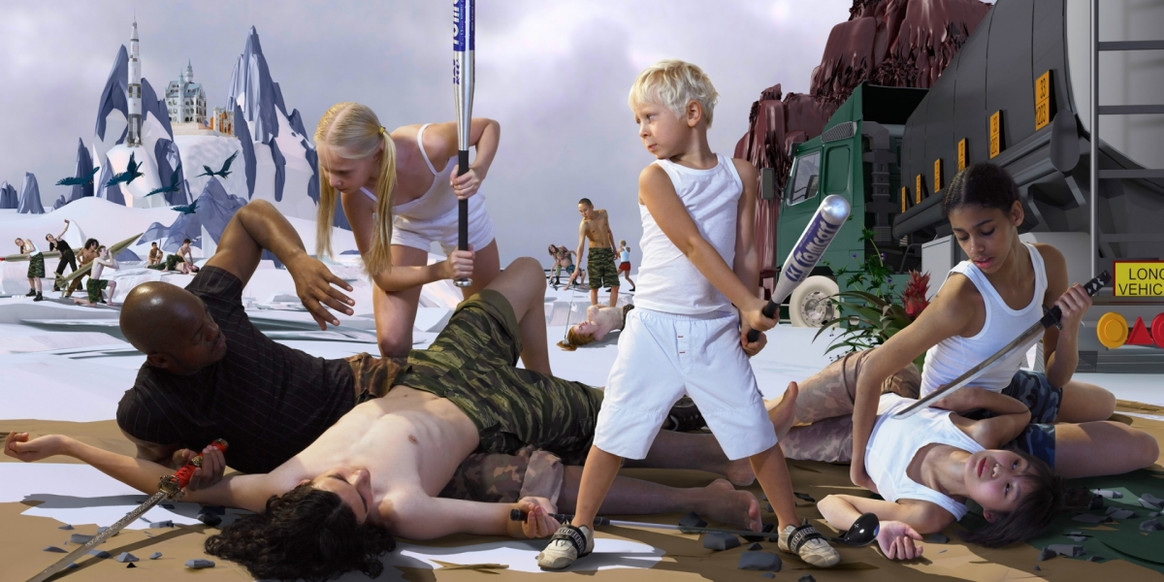
AES+F group (Tatiana Arzamasova, Lev Evzovich, Evgeny Svyatsky + Vladimir Fridkes) is characterized by a very rigid formulation of philosophical, existential and social issues, the utmost articulation of an artistic concept with a pronounced prophetic orientation.

Each of their new projects is a kind of provocation, causing our habitual ideas about good and evil, sin and innocence, virtue and vice to burst at the seams. Their work always reflects the global socio-cultural situation, not yet manifested, but already in the air. They make you feel and think about the present in a way that is ahead of time.
Way
2006
Digital collage, chromogenic print
100 × 200 cm (on canvas)
60 × 120 cm (on paper)
2006
Digital collage, chromogenic print
100 × 200 cm (on canvas)
60 × 120 cm (on paper)
Way
2006
Digital collage, chromogenic print
100 × 200 cm (on canvas)
60 × 120 cm (on paper)
2006
Digital collage, chromogenic print
100 × 200 cm (on canvas)
60 × 120 cm (on paper)
Each of their new projects is a kind of provocation, causing our habitual ideas about good and evil, sin and innocence, virtue and vice to burst at the seams. Their work always reflects the global socio-cultural situation, not yet manifested, but already in the air. They make you feel and think about the present in a way that is ahead of time.
The Liminal Space trilogy*, the first joint presentation of three video projects by the AES+F group — "The Last Uprising" (first shown in the Russian pavilion at the Venice Biennale 2007), "Feast of Trimalchio" (first shown in Venice in 2009), Allegoria Sacra (premiered in 2011 at the Multimedia Art Museum as part of a parallel program Moscow Biennale of Contemporary Art). The trilogy is an attempt to analyze the globalized reality of the 21st century from the point of view of traditional landmarks that have defined the structure of the universe for many centuries: heaven, hell, purgatory.

The Liminal Space trilogy*, the first joint presentation of three video projects by the AES+F group — "The Last Uprising" (first shown in the Russian pavilion at the Venice Biennale 2007), "Feast of Trimalchio" (first shown in Venice in 2009), Allegoria Sacra (premiered in 2011 at the Multimedia Art Museum as part of a parallel program Moscow Biennale of Contemporary Art). The trilogy is an attempt to analyze the globalized reality of the 21st century from the point of view of traditional landmarks that have defined the structure of the universe for many centuries: heaven, hell, purgatory.

The artists started the Trimalchio Feast project in the early 2000s, when the contours of total consumerism and narcissism that defined the pre-crisis period of the second half of the noughties were just beginning to appear. Work on the project was completed already at the peak of the post-crisis agony. The detached and thrilling action of the Trimalchio Feast, which takes place in a multi-star hotel, a symbol of pleasure and prosperity, turned out to be a magical mirror reflecting time and its evil, self-perpetuating component. The world of people engaged in self-indulgence, where "servants" and "masters" change roles in accordance with the geopolitical and socio-economic shifts in modern civilization, is undergoing absurd self-disintegration. The Feast of Trimalchio has an indirect reference to ancient literature, and first of all, the work of Petronius. However, sometimes history develops in a spiral, and it is difficult not to recall Verlaine’s words: "Oh, the Roman world of the period of decline…"
The artists started the Trimalchio Feast project in the early 2000s, when the contours of total consumerism and narcissism that defined the pre-crisis period of the second half of the noughties were just beginning to appear. Work on the project was completed already at the peak of the post-crisis agony. The detached and thrilling action of the Trimalchio Feast, which takes place in a multi-star hotel, a symbol of pleasure and prosperity, turned out to be a magical mirror reflecting time and its evil, self-perpetuating component. The world of people engaged in self-indulgence, where "servants" and "masters" change roles in accordance with the geopolitical and socio-economic shifts in modern civilization, is undergoing absurd self-disintegration. The Feast of Trimalchio has an indirect reference to ancient literature, and first of all, the work of Petronius. However, sometimes history develops in a spiral, and it is difficult not to recall Verlaine’s words: "Oh, the Roman world of the period of decline…"
© All rights reserved.
Free admission
Daily from 11:00 AM to 8:00 PM
WE ARE OPEN
Contacts
MENU
