Free admission
Вход свободный
Daily from 11:00 AM to 8:00 PM
| Free admission
 Home
Home
TRILOGY. FINAL CUT
AES+F
April 26 — May 12, 2013
Triumph gallery
Triumph gallery
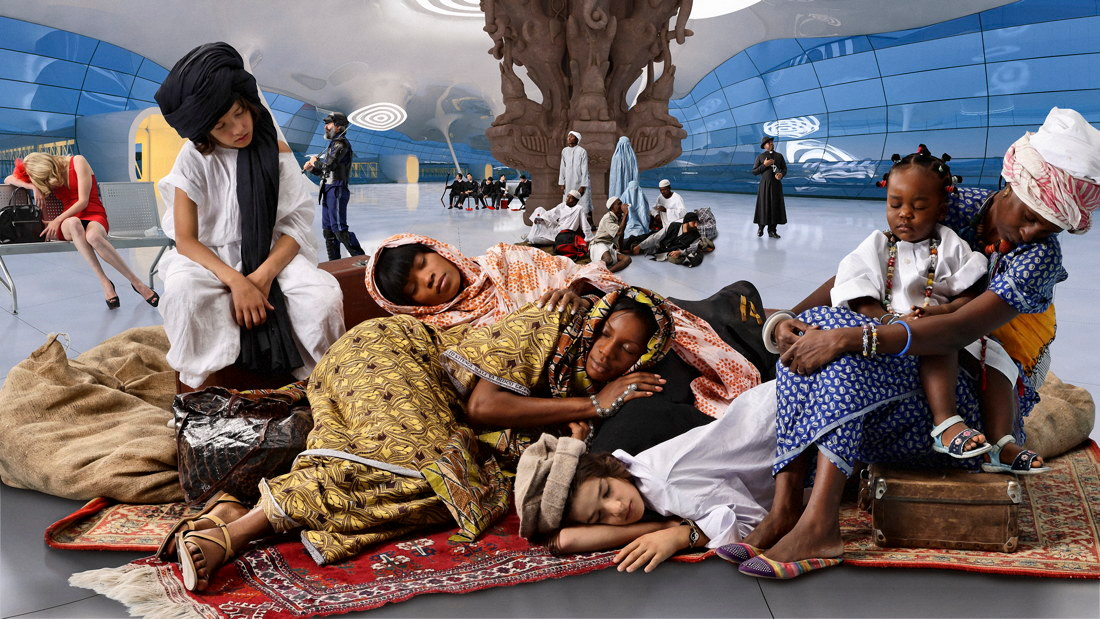
In 2012, AES+F presented the large-scale exhibition project "Trilogy", which premiered at two venues simultaneously — the Central Exhibition Hall "Manege" (Moscow) and the Martin-Gropius-Bau (Berlin). In May of this year, the entire project will also be shown at the Faena Arts Center (Buenos Aires). The "Trilogy", which the artists have been working on for the past seven years, was conceived as a story about the modern world and consistently presents the concepts of Hell ("The Last Uprising", 2007), Paradise ("The Feast of Trimalchio", 2009), and Purgatory (Allegoria Sacra, 2011) through the lens of today’s worldview. After the major exhibitions, AES+F will present a post scriptum exhibition titled "Trilogy" in the intimate space of the Triumph Gallery. Final Cut", where the viewer will be able to learn about the details of the project and the process of its creation.

The combination of Renaissance and Baroque art techniques with the aesthetics of cinema and video games distinguishes AES+F's high-tech works. For example, the multi-figure compositions in "The Last Uprising" refer to the famous painting "The Raft of the Medusa" by Theodore Géricault and the works of Caravaggio, while the frames in "The Feast of Trimalchio" are inspired by Engraud’s paintings and Pompeian frescoes.
Allegoria Sacra
2007
Still frame 1-02 from the video, printed on paper
39’ 43’’
2007
Still frame 1-02 from the video, printed on paper
39’ 43’’
Allegoria Sacra
2007
Still frame 1-02 from the video, printed on paper
39’ 43’’
2007
Still frame 1-02 from the video, printed on paper
39’ 43’’
The combination of Renaissance and Baroque art techniques with the aesthetics of cinema and video games distinguishes AES+F's high-tech works. For example, the multi-figure compositions in "The Last Uprising" refer to the famous painting "The Raft of the Medusa" by Theodore Géricault and the works of Caravaggio, while the frames in "The Feast of Trimalchio" are inspired by Engraud’s paintings and Pompeian frescoes.
Giovanni Bellini’s work, titled Allegoria Sacra, inspired AES+F to create a video of the same name, which became the final part of the "Trilogy." The allegorical characters from Bellini’s painting, including a centaur, ancient philosophers, Christian saints, and biblical figures, are transformed into passengers in an airport lounge, where they are escorted by flight attendants from Stanley Kubrick’s "2001: A Space Odyssey."

Giovanni Bellini’s work, titled Allegoria Sacra, inspired AES+F to create a video of the same name, which became the final part of the "Trilogy." The allegorical characters from Bellini’s painting, including a centaur, ancient philosophers, Christian saints, and biblical figures, are transformed into passengers in an airport lounge, where they are escorted by flight attendants from Stanley Kubrick’s "2001: A Space Odyssey."

Javier Panera, art critic, curator and former director of Domus Artium 2 (the Salamanca Center for Contemporary Art) defines the paradoxical nature of the Russian group’s work as follows: "AES+F's works, like all non-baroque works, are nourished by moral and cultural paradoxes such as seduction and threat, hyperrealism and artificiality, classicism and modernity, spirituality and sensuality, historicism and the end of history."
Javier Panera, art critic, curator and former director of Domus Artium 2 (the Salamanca Center for Contemporary Art) defines the paradoxical nature of the Russian group’s work as follows: "AES+F's works, like all non-baroque works, are nourished by moral and cultural paradoxes such as seduction and threat, hyperrealism and artificiality, classicism and modernity, spirituality and sensuality, historicism and the end of history."
© All rights reserved.
Free admission
Daily from 11:00 AM to 8:00 PM
WE ARE OPEN
Contacts
MENU
